Sicán museum guide
Chiclayo: Pómac Forest Sanctuary & Sicán Museum
What is the Sicán museum?
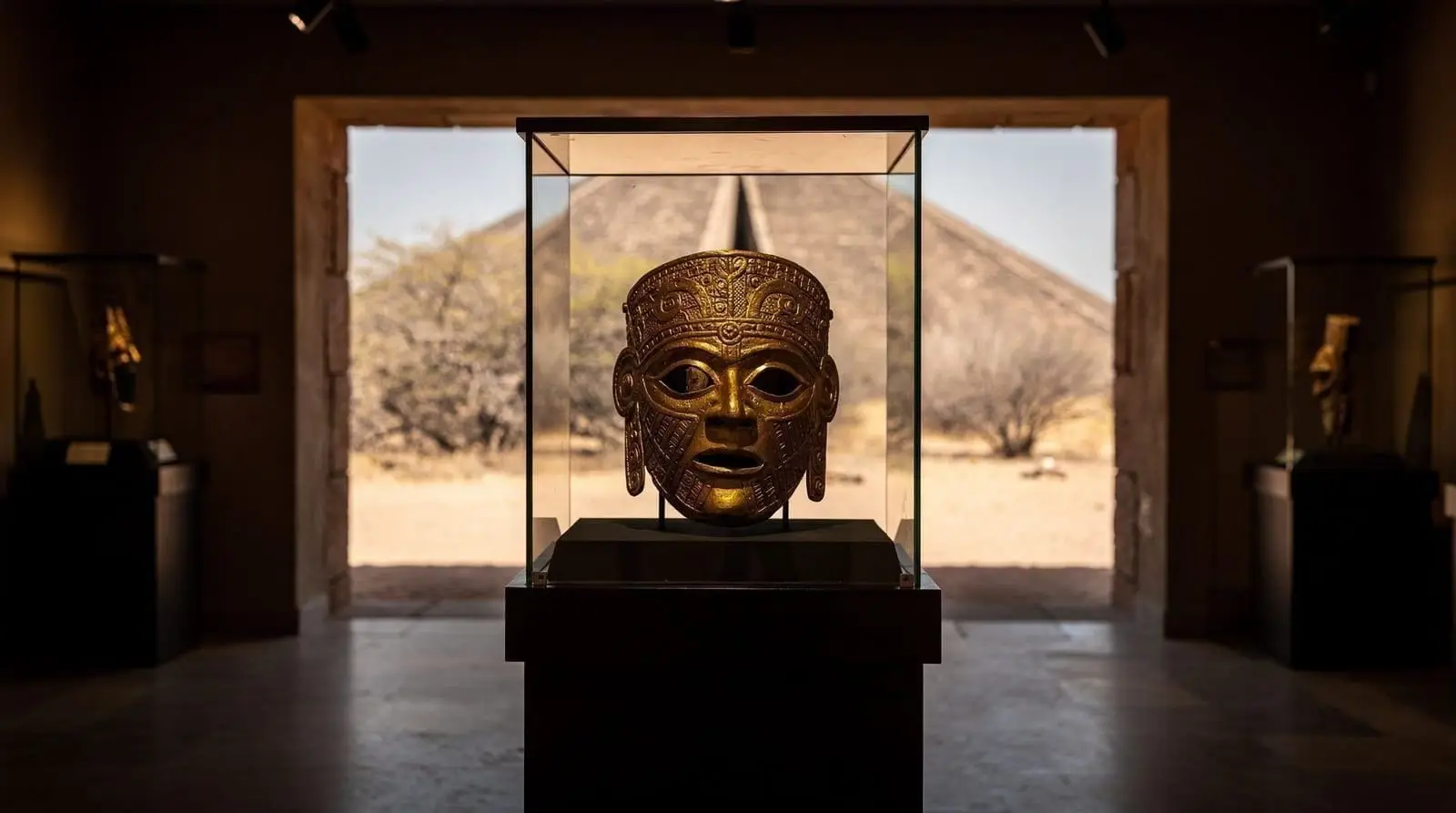
The Museo Nacional Sicán in Ferreñafe, 18 km from Chiclayo, displays the Lambayeque (Sicán) culture and its royal tombs from the Pómac forest, including a famous inverted burial with a gold funerary mask. It pairs with the Pómac forest sanctuary 16 km away.
The gold-working culture that buried its lords upside-down
Between the fall of the Moche and the rise of the Chimú, a culture archaeologists call Sicán — or Lambayeque — dominated the north coast of Peru from roughly 750 to 1375 CE. They were master metallurgists, producing tumbaga (a gold-copper alloy) objects on an almost industrial scale and distributing them by trade across western South America. Their religious centre was Batán Grande, a cluster of pyramid mounds in what is now the Bosque de Pómac, and their royal tombs there held some of the richest burials ever found in the Americas — including more gold, by weight, than the famous Lord of Sipán.
The story of the Sicán is told in two linked places near Chiclayo: the Museo Nacional Sicán in the town of Ferreñafe, where the artefacts and tomb reconstructions live, and the Bosque de Pómac, the dry-forest sanctuary where the mounds and royal graves were excavated. This guide covers both, how they connect, what they cost, and how to fit them into a Chiclayo trip. The Chiclayo complete guide places them in the region’s two-day circuit.
| Where | Ferreñafe (18 km NE of Chiclayo) and Bosque de Pómac (16 km S) |
| Cost | museum S/10; Pómac around S/8-10; combined tour S/80-120 |
| Time needed | 90 min museum, 2-3 hrs Pómac — a comfortable full day together |
| Getting there | colectivo to Ferreñafe (S/3-5); taxi or tour for Pómac |
| Best time | dry season (May-October) for the forest and birdwatching |
The Museo Nacional Sicán in Ferreñafe
Opened in 2001, the Museo Nacional Sicán in Ferreñafe (18 km northeast of Chiclayo) is a purpose-built, well-organised museum dedicated entirely to the Lambayeque culture. Its centrepiece is a full-scale reconstruction of the East Tomb of Huaca Loro, excavated by the Japanese-Peruvian archaeologist Izumi Shimada in the early 1990s. The tomb is extraordinary in two ways.
First, the lord was buried inverted — placed upside-down in a seated position, with his head detached and reoriented, a funerary practice unique to the Sicán elite. Second, the sheer volume of grave goods: over a tonne of objects including a famous gold funerary mask painted with cinnabar, gold gloves and shin guards, ceremonial knives (tumis), and the bodies of attendants and sacrificed women.
The displays also cover Sicán metallurgy in detail — how they smelted, alloyed and hammered metal — alongside the distinctive Sicán ceramic style with its almond-eyed “Sicán Lord” face that appears on countless objects. Labelling is bilingual and clearer than at most Peruvian sites, though a guide still adds depth on the cosmology behind the inverted burials.
Admission is S/10 (USD 2.70). Hours are typically 9am to 5pm, closed Mondays. Allow about 90 minutes. For a booking that pairs the museum with the Pómac forest and transport from Chiclayo, the standard option is:
Chiclayo: Pómac Forest Sanctuary & Sicán MuseumThe Bosque de Pómac sanctuary
Sixteen kilometres south of Chiclayo, the Santuario Histórico Bosque de Pómac protects the last major stand of algarrobo (carob) dry forest in the Lambayeque valley — the same woodland that once covered the whole coastal plain before agriculture cleared it. Within the forest stand more than 30 Sicán pyramid mounds, the heart of the old Batán Grande religious centre, including the Huaca Loro and Huaca Las Ventanas that yielded the museum’s gold.
The experience here is unlike the open desert of Túcume or Sipán. You walk shaded trails beneath gnarled carob trees — some over 500 years old — with the mud-brick mounds emerging through the grey-green canopy. The sanctuary is one of the best birdwatching sites on the north coast, with over 80 recorded species including the endemic Peruvian plantcutter, the Peruvian thick-knee, and various hummingbirds and woodpeckers; the dry season (May–October) is prime. A signature stop is the Árbol Milenario, a vast ancient algarrobo with a sprawling, sculptural form.
Entrance is around S/8–10. The interpretive centre at the entrance orients visitors; from there, trails and a road lead to the mounds and viewpoints. Walking, cycling and horseback options exist depending on the operator. Allow two to three hours to do it justice. Note that the forest and the Ferreñafe museum are on opposite sides of Chiclayo and not linked by public transport, which is why a tour or hired taxi makes the day work.
Combining the Sicán sites
Because the Pómac forest is south of Chiclayo and Ferreñafe is northeast, and because Túcume sits nearby to the north, the three are usually combined across a single full day or split with Túcume. The most efficient guided plan covers Túcume, Pómac and the Sicán museum together:
Chiclayo: Túcume Pyramids and Pómac ForestDoing it independently means a hired taxi for the day (S/150–200), since chaining colectivos between the three points wastes hours. The Chiclayo complete guide lays out the recommended two-day split — Sipán on day one, this northern loop on day two.
Who the Sicán were
It is worth understanding the culture before you stand in front of its tombs, because the Sicán are easy to confuse with their neighbours. They emerged around 750 CE in the Lambayeque valley, in the gap left by the collapse of the Moche, and they reached their peak — the Middle Sicán period, roughly 900–1100 CE — as one of the most productive metalworking societies the Americas ever produced. Archaeologist Izumi Shimada’s decades of excavation at Batán Grande revealed industrial-scale smelting operations: furnaces, slag heaps and workshops that turned out arsenical copper and tumbaga in quantities far beyond local need, traded across a network reaching from Colombia to Chile.
Their art is instantly recognisable once you know it. The “Sicán Lord” — a figure with a distinctive mask-like face and upturned, almond-shaped eyes — recurs on ceramics, gold masks and ceremonial knives, almost certainly representing a deity or deified ancestor associated with the moon (the name Sicán itself means “house” or “temple of the moon” in the local Muchik language). This lunar focus distinguishes them from the sun-oriented cultures of the central Andes and recurs throughout the museum’s displays.
Around 1100 CE a severe drought, likely an extended El Niño disruption, undermined the elite’s authority — the religion that promised to control water had failed — and Batán Grande was deliberately burned, probably in a popular revolt. Power shifted north to Túcume in the Late Sicán period, before the Chimú conquest around 1375 CE ended the culture’s independence. Knowing this arc turns the museum’s gold from pretty objects into the surviving evidence of a sophisticated society’s rise and fall.
How the Sicán fit the bigger picture
Understanding the Sicán makes the rest of the Chiclayo region cohere. They came after the Moche who built Sipán, built the early phases of Túcume, and were eventually conquered around 1375 CE by the Chimú whose capital was Chan Chan near Trujillo. The Moche and Chimú civilisations guide traces this succession of north-coast powers, with the Sicán as the crucial middle chapter between them.
Practical logistics and money
A few specifics that make the day run smoothly. Carry cash in soles: neither the Ferreñafe museum entrance (S/10) nor the Pómac sanctuary fee (around S/8–10) reliably takes cards, and there is no ATM at either site. The museum is closed on Mondays, like most of the region’s archaeology, so do not build your itinerary around a Monday visit. The Pómac interpretive centre at the entrance is the place to confirm which trails and mounds are currently open, since the sanctuary occasionally restricts access for conservation or after El Niño damage.
For reaching the sites independently, frequent colectivos run from Chiclayo to Ferreñafe (S/3–5, about 30 minutes), making the museum easy to do on its own as a half-day. Pómac is the harder one: it lies via Batán Grande, with patchier public transport, so a hired taxi (S/120–160 round trip) or a tour is the practical way in. Because the museum and the forest sit on opposite sides of Chiclayo, anyone wanting both in a day should book transport rather than improvise with colectivos.
If you are choosing a single tour, the combinations that work best are the Túcume-plus-Pómac northern loop (which folds in the broader landscape) or the focused Pómac-plus-Sicán-museum pairing for visitors whose main interest is the Lambayeque culture itself. Either way, an English-speaking guide should be requested in advance through a Chiclayo agency, as on-the-day English is not guaranteed.
Honest cautions
A few practical notes. First, the museum and the forest are genuinely separate visits on opposite sides of the city — do not assume “Sicán” means a single stop, and budget transport accordingly. Second, the forest is most rewarding in the dry season; in the wet months trails can be muddy and the birdlife thinner, and El Niño years occasionally close sections. Third, bring water, sun protection and insect repellent for Pómac — it is woodland, but the sun is strong and mosquitoes appear near water. Finally, the museum bans flash photography around the gold; respect the rules to keep access open.
Sicán, Sipán and Túcume: telling the museums apart
Chiclayo’s three headline archaeology sites are easy to blur together on a short trip, so it is worth being explicit about what each one actually offers. Sipán is the Moche site — earlier, and famous for the intact tomb of the Lord of Sipán with its warrior-priest regalia. Sicán/Lambayeque, covered here, is the later gold-and-metallurgy culture with the unique inverted-burial tradition and the atmospheric Pómac dry forest.
Túcume is the vast field of adobe pyramids that Sicán’s rulers built and later expanded, and where power shifted after Batán Grande was burned. Seeing all three in sequence — Sipán, then Sicán, then Túcume — traces the region’s history in the correct chronological order, which the Moche and Chimú civilisations guide lays out in full.
For travellers who prefer a first-person account before committing a day to the museum-and-forest combination, the Trujillo Moche trail diary blog post covers the broader north-coast archaeology circuit, including how the different sites compare in pacing and payoff.
Frequently asked questions about Sicán museum
What is the difference between Sicán and Lambayeque?
How much does the Sicán museum cost?
What is the inverted royal tomb at Sicán?
Is the Pómac forest worth visiting?
How do I get to Ferreñafe and Pómac from Chiclayo?
How long do you need for the Sicán museum and Pómac?
Is the Sicán museum worth visiting if I have already seen Sipán?
Top experiences
Bookable activities with verified prices and instant confirmation on GetYourGuide.
