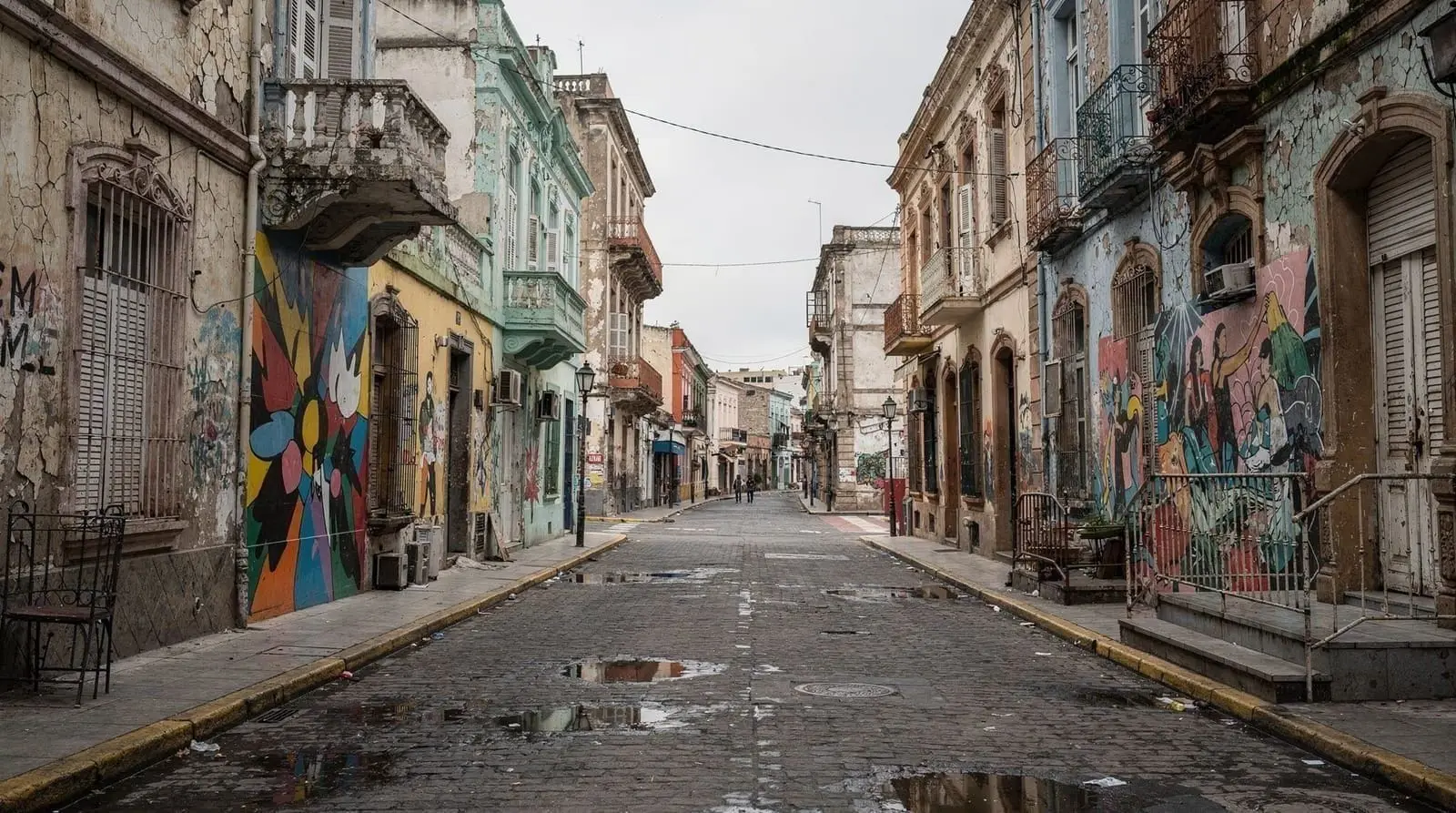
Callao Monumental
Honest guide to Callao Monumental, Lima's regenerated port quarter: street art, galleries, real safety advice, how to get there, and what to skip.
Lima: Monumental Day in Callao
Quick facts
- District
- Callao (Barrio Castilla / La Punta side)
- Distance from Miraflores
- ~14 km / 35-50 min by taxi
- Known for
- Street-art murals, artist studios, regenerated old port buildings
- Cost
- Free to walk; some galleries and events ticketed
- Best for
- Street art, contemporary galleries, urban-regeneration interest
A port district that reinvented itself
Callao is technically not part of Lima at all — it is a separate constitutional province, Peru’s main seaport, and home to the international airport. For most travellers it registers only as the place where their plane lands. But in the historic core of Callao, in a once-notorious quarter near the old customs houses, sits one of the most interesting urban-regeneration stories in South America: Callao Monumental.
| Where | Barrio Castilla, Callao, ~14 km from Miraflores |
| Time needed | Half a day, daytime only |
| Cost | Free to walk; guided tour or gallery purchases extra |
| Getting there | App-based taxi door to door, S/30–45 each way |
| Best time | First Saturday of the month (open-studios event) |
The neighbourhood, sometimes called the Barrio Castilla, was for decades a no-go zone — a faded port slum associated with crime and the drug trade, full of grand but crumbling early-20th-century buildings. Beginning around 2015, a private cultural initiative (Fugaz / Proyecto Monumental Callao) restored a cluster of these buildings, brought in artists to take over apartments as studios, and commissioned large-scale murals on the facades. The result is a compact district of bold street art, working galleries, cafés, and a slowly recovering sense of life. It is not a finished, gentrified zone — it remains an island of regeneration inside a rough wider area — and that tension is exactly what makes it worth understanding before you go.
Quick answer: is Callao Monumental worth the trip?
For street-art lovers and travellers curious about urban regeneration, yes — but treat it as a deliberate, daytime, guided-or-grouped visit, not a casual stroll. The murals are genuinely impressive and the galleries are real working spaces. For a general first-time visitor with limited Lima days, Barranco offers a comparable street-art and gallery experience much closer to where you are staying and with far less safety friction.
What you actually see there
The heart of the district is a handful of streets around Jirón Constitución and the restored Casa Fugaz and Casa Ronald buildings. Within a few blocks you will find:
- Large-scale facade murals by Peruvian and international street artists, repainted and added to over the years. These are the main draw and the reason photographers come.
- Artist studios inside the restored apartment buildings. Many open to the public during the monthly open-studios event, when you can walk in and meet the painters, ceramicists, and designers who work there.
- Galleries and design shops selling contemporary Peruvian art, prints, and crafts at prices well below the tourist-strip markups in Miraflores.
- Cafés and a couple of bars within the secured core, pleasant for a coffee or a drink while you take in the scene.
The single best time to visit is the first Saturday of each month, when the district holds its open-studios and cultural event. Streets are pedestrianised, security is heaviest, families and locals fill the area, and the atmosphere is at its liveliest. Outside that event the district is much quieter and some studios are closed.
A guided full-day visit is the most comfortable way to experience Callao for a first-timer, because the guide handles the routing and the local context. The monumental day in Callao tour covers the murals, the restored buildings, and usually the wider port context, which turns an otherwise tricky independent outing into a straightforward half-day.
What locals and repeat visitors say about it
Ask around Lima and opinions on Callao Monumental split fairly cleanly along the lines you’d expect. Street-art enthusiasts and photographers who have been several times tend to rate it above Barranco for sheer visual impact — the scale of the murals and the rawness of the setting genuinely is different from anything in the city’s wealthier districts. First-time visitors and families, on the other hand, more often report that the safety logistics outweighed the payoff, especially if they went without a guide.
The consistent thread in both camps is that a guided visit resolves most of the friction: nobody who went with a knowledgeable guide reports regretting the trip, while a meaningful share of independent, under-researched visits end in an anxious, rushed half-day. That is the single most useful piece of secondhand advice to take from other travellers’ experiences here.
How the regeneration actually happened
The story behind Callao Monumental is worth knowing, because it shapes what you see and explains the slightly uneasy atmosphere. The buildings here date mostly from the late 19th and early 20th centuries, when Callao was a booming, cosmopolitan port — the gateway through which Peru’s guano wealth, and later its imports and emigrants, passed. Grand apartment houses and commercial blocks went up in styles ranging from neoclassical to art deco.
When the port economy contracted and containerisation moved cargo handling elsewhere in the 20th century, the old core decayed. By the late 1990s and 2000s the quarter had become one of the most dangerous parts of metropolitan Lima, controlled in places by gangs and the drug trade, with the historic buildings left to rot.
The turnaround began around 2014–2015 with a private cultural-development venture (operating under the Fugaz / Monumental Callao banner) that bought and restored a cluster of the buildings, offered subsidised studio space to artists, and curated a programme of murals, galleries, and events. The model is deliberate urban acupuncture: rather than trying to fix all of central Callao at once, it created a secured, vibrant island in the hope it would radiate outward. Whether it has truly lifted the surrounding blocks is debatable, and that is precisely why the safety advice below is non-negotiable. You are visiting a successful intervention inside an area that is still recovering, not a finished neighbourhood.
Understanding this also changes how you read the art. Many of the murals and installations engage directly with Callao’s identity — its maritime history, its Afro-Peruvian and immigrant communities, its reputation and its recovery — rather than being decorative tourist backdrops. A good guide will draw out these references.
A practical photographer’s brief
If you are coming for the murals specifically, a few notes from people who shoot here:
- Light is best mid-morning to early afternoon. The facades face various directions and the streets are narrow, so harsh midday overhead light can flatten the larger works; the softer angles earlier and later in the day read better. The coastal garúa fog (May–October) actually diffuses the light pleasantly, even if the sky is dull.
- Wide lenses earn their keep. Many murals run the full height of multi-storey buildings on tight streets, so a wide angle or a panorama mode helps you capture them whole.
- Be discreet with gear. A single camera or phone is fine inside the secured core, but do not arrive laden with conspicuous equipment, and keep it put away on the taxi ride in and out. This is the one district in greater Lima where flashing expensive kit on the street is a genuine risk.
- The murals change. Works are repainted and replaced over time, so do not arrive expecting a specific piece you saw online — treat the whole quarter as the attraction rather than any single wall.
La Punta and the wider Callao
If you make the trip out to Callao, it is worth extending it slightly. A few kilometres west sits La Punta, the narrow residential spit at the very tip of the peninsula. It is a calm, distinctly middle-class neighbourhood of early-20th-century seaside villas, with a long malecón, a pebble beach, and views back across the bay to the islands of San Lorenzo and El Frontón. It feels nothing like the regenerated art quarter — quiet, safe, faintly nostalgic — and the contrast tells you a great deal about Callao’s social geography.
Offshore lies the Real Felipe Fortress (Fortaleza del Real Felipe), the largest Spanish colonial fortress in the Americas, built in the 18th century to defend the port against pirates and later the focus of the wars of independence. Entry runs around S/20 / about $5 and includes a museum of military history. It is a solid stop if your interests run to colonial and independence-era history, and it sits close to the Monumental district.
The fortress is a genuine highlight and the strongest reason to extend a Callao visit. Begun in 1747 after the catastrophic earthquake and tsunami that destroyed the old port the previous year, it is a vast pentagonal stronghold whose ramparts and towers once mounted scores of cannon facing the bay. It was the last royalist holdout in South America, falling to the independence forces only in 1826 after a long siege.
Today the guided circuit takes you through the powder magazines, the King’s and Queen’s towers, and the dungeons, with a small but engaging collection of weapons, uniforms, and naval history. Allow about 90 minutes. Because it sits within the secured, more orderly part of Callao near La Punta, it is also a comfortable place to spend time without the caution the Monumental quarter demands.
Gastón Acurio’s Chicha and a handful of newer seafood restaurants have opened in the regenerated zones, capitalising on Callao’s identity as the source of Lima’s fish. If you are out here at lunchtime, eating fresh ceviche a stone’s throw from the working fishing harbour is the most authentic possible setting for it — just confirm with your guide or driver which specific places sit within the safe, recommended area.
Eating in and around the Monumental district
A handful of restaurants have opened in the regenerated zones and the safer stretches near La Punta, capitalising on Callao’s identity as the source of much of Lima’s fish. Chicha, part of chef Gastón Acurio’s restaurant group, is the best-known option and serves reliable Peruvian coastal cooking in a comfortable setting. A few newer independent seafood spots have followed its lead. If eating here is part of your plan, confirm with your guide or driver exactly which restaurants sit within the recommended, secured area — Callao’s dining scene, unlike Barranco’s, is not yet dense enough to simply wander between options.
Combining Callao with an airport transfer
Because Jorge Chávez International Airport sits within Callao, the Monumental district makes an unusually practical stop on a departure day — far more so than most Lima attractions, which require a detour back toward the coast. If your flight leaves in the evening, a morning visit to the murals followed by lunch and a slow taxi to the terminal can turn dead layover hours into a genuinely worthwhile half-day.
Build in a generous traffic buffer (Lima-Callao traffic is unpredictable) and confirm your hotel checkout and luggage logistics before committing to this plan — it works best if you have already checked out and are travelling with cabin luggage only, since dragging suitcases around the Monumental district is neither practical nor advisable from a safety standpoint.
Getting there and the honest safety brief
Callao Monumental is about 14 km from Miraflores — roughly 35–50 minutes by taxi depending on traffic. This is where honesty matters most:
Go by app-based taxi, door to door. Use Cabify, InDriver, or Uber. Expect S/30–45 / about $8–12 each way. Have the driver drop you inside the secured core of the Monumental district, not on its outer edge, and arrange your return pickup from the same point. Do not walk in from a distance, and do not wander out of the patrolled zone on foot.
Visit in daylight, ideally in a group or with a guide. The Monumental core is patrolled and safe during the day, especially on event Saturdays. The surrounding blocks of central Callao are not, and the line between the two is not always obvious from the street. This is the genuine reason a guided tour pays for itself here in a way it might not in Miraflores.
Do not bring valuables you do not need. A camera or phone is fine inside the secured zone, but be discreet getting in and out. Leave jewellery, second cameras, and large amounts of cash at your hotel.
Avoid evenings and the wider port at night entirely. Once the daytime crowds and security thin out, this is not an area for tourists on foot.
None of this is meant to scare you off — thousands of visitors enjoy Callao Monumental safely every month. It simply does not forgive carelessness the way the cliff-top tourist districts do.
Should you go, or stay in Barranco?
Be honest with yourself about your Lima time. If you have two days, spend them on the Lima essentials — the food, the Historic Center, the Huaca Pucllana pyramid, and an evening in Barranco, which has its own excellent street art, galleries, and the famous Bridge of Sighs, all within a short walk and with none of Callao’s friction.
Callao Monumental earns its place on a third or fourth day, or for travellers with a specific interest in street art and urban regeneration. If that is you, it is one of the more distinctive half-days greater Lima offers — a real neighbourhood reinventing itself, not a manufactured attraction.
A bicycle tour is a pleasant way to compare the city’s street-art scenes if you prefer to base yourself in the safer districts. The Miraflores, Malecón and Barranco street-art bike tour covers the cliff-top murals and Barranco’s art quarter without the Callao logistics, and is a good alternative if Callao does not fit your schedule.
Barranco vs. Callao Monumental at a glance
| Barranco | Callao Monumental | |
|---|---|---|
| Distance from Miraflores | ~15 min taxi | ~35–50 min taxi |
| Safety | Safe day and night, walkable | Daytime, secured-core only |
| Art style | Organic, integrated with neighbourhood | Large-scale, politically charged, curated |
| Extras | Bridge of Sighs, bars, galleries | Real Felipe Fortress, La Punta, regeneration story |
| Best for | Most first-time Lima visitors | Travellers with 3+ Lima days and a street-art focus |
The honest comparison, point by point
For Barranco: it is fifteen minutes from Miraflores, walkable, safe day and night, and packed with murals, galleries, artisan shops, the Bridge of Sighs, and Lima’s best bar strip. It is the obvious choice if your street-art interest is part of a broader sightseeing day.
For Callao Monumental: it is rawer, more confronting, and tells a more dramatic regeneration story, with larger-scale and more politically charged murals. But it costs you a half-day, requires careful logistics, and is only comfortable on the monthly event day or with a guide. The artistic payoff is real, but it is for travellers who specifically value street art and urban renewal over convenience.
If you are torn, a useful rule of thumb: do Barranco regardless, and add Callao only if you have at least three full days in Lima and a genuine appetite for it. Trying to cram Callao into a two-day Lima stop almost always comes at the expense of something more rewarding.
Practical planning notes
Cost: walking the murals and the public streets of the secured core is free. You pay only for a guided tour if you take one, for gallery purchases, food, and the Real Felipe Fortress (around S/20 / about $5). Budget S/60–120 / about $16–32 all-in for a self-guided half-day including taxis and a meal, more if you book a full guided tour.
Timing: aim to arrive mid-morning and leave by mid-to-late afternoon. The district is at its best and safest in daylight, and you do not want to be arranging a taxi out as dusk falls. On the first-Saturday event days, go earlier rather than later — the crowds and energy build through the day but so does the difficulty of finding a taxi back.
What to bring: comfortable walking shoes, sun protection (the port has little shade), water, and a single discreet camera or phone. Carry small amounts of cash for galleries, snacks, and the fortress, and leave passports and valuables at your hotel — a photo of your ID on your phone is enough for the day.
Accessibility: the restored core is reasonably flat and walkable, but pavements in central Callao are uneven and the wider area is not designed for wheelchairs. The Real Felipe Fortress involves stairs and ramparts.
Language: little English is spoken in Callao outside the curated cultural venues. A guided tour or a few words of Spanish will smooth the experience considerably, and a translation app covers the rest.
How it fits into a Lima itinerary
Treat Callao as a self-contained half-day, not something to squeeze between other stops. Pair the Monumental district with the Real Felipe Fortress and a quiet hour in La Punta for a coherent Callao outing, then return to your home district for the evening. It works well on the day you fly out, since the airport is in Callao anyway — though build in a generous buffer for traffic if you do this.
For the full Lima overview and how many days the city deserves, see the Lima destination guide. Browse the guides hub for deeper planning, the itineraries for sample routes, the tours hub to compare guided options, and the tools section for budget and timing calculators.
Frequently asked questions about Callao Monumental
Is Callao Monumental safe to visit?
The secured Monumental core is safe in daytime, especially on the first-Saturday event days when security and crowds are heaviest. The surrounding blocks of central Callao are not safe for tourists on foot, and the boundary is not always obvious. Arrive and leave by app-based taxi dropped inside the core, visit in daylight, and ideally go with a guide or in a group. Avoid the area entirely at night.
How do I get to Callao Monumental from Miraflores?
Take an app-based taxi (Cabify, InDriver, Uber) door to door — about 14 km and 35–50 minutes, costing S/30–45 / about $8–12 each way. Ask the driver to drop you inside the secured Monumental zone and arrange a return pickup from the same spot. Public transport into central Callao is not recommended for visitors.
When is the best time to go?
The first Saturday of each month, when the district holds its open-studios cultural event. Streets are pedestrianised, artist studios open to the public, security is at its highest, and the atmosphere is liveliest. Outside that event the district is quieter and some studios are closed, though the murals are visible any daytime.
What is there to see?
Large-scale street-art murals on restored port buildings, working artist studios (open during the monthly event), contemporary galleries and design shops, and a few cafés and bars within the secured core. Nearby you can add the colonial Real Felipe Fortress and the quiet seaside neighbourhood of La Punta for a fuller Callao outing.
Is it better than Barranco for street art?
Both are worth seeing, but they suit different trips. Barranco offers comparable murals, galleries, and a famous bohemian atmosphere a short walk from where most visitors stay, with far less safety friction. Callao Monumental is more raw and distinctive, with a genuine urban-regeneration story, but requires more planning and caution. For a first short visit, Barranco wins; for a deeper street-art interest, do both.
Do I need a guided tour for Callao?
It is strongly recommended for first-time visitors. A guide handles the routing, keeps you inside the safe zone, and explains the regeneration story and the artists behind the murals. Independent visits are possible if you are disciplined about taxis and timing, but the guided format removes most of the friction that makes Callao trickier than Lima’s cliff-top districts.
Can I visit Callao Monumental on my way to or from the airport?
Yes, and it is one of the more practical uses of dead layover time in Lima, since Jorge Chávez Airport sits within Callao. A morning visit followed by a taxi to the terminal works well for evening departures, but travel light — cabin luggage only — and build in a generous traffic buffer.
Is there anywhere to eat near the Monumental district?
A small but growing cluster of restaurants has opened in the regenerated zones and near La Punta, including Chicha, part of chef Gastón Acurio’s group. Confirm with your guide or driver which specific restaurants sit within the recommended, secured area before walking there independently.
Top experiences
Bookable activities with verified prices and instant confirmation on GetYourGuide.
