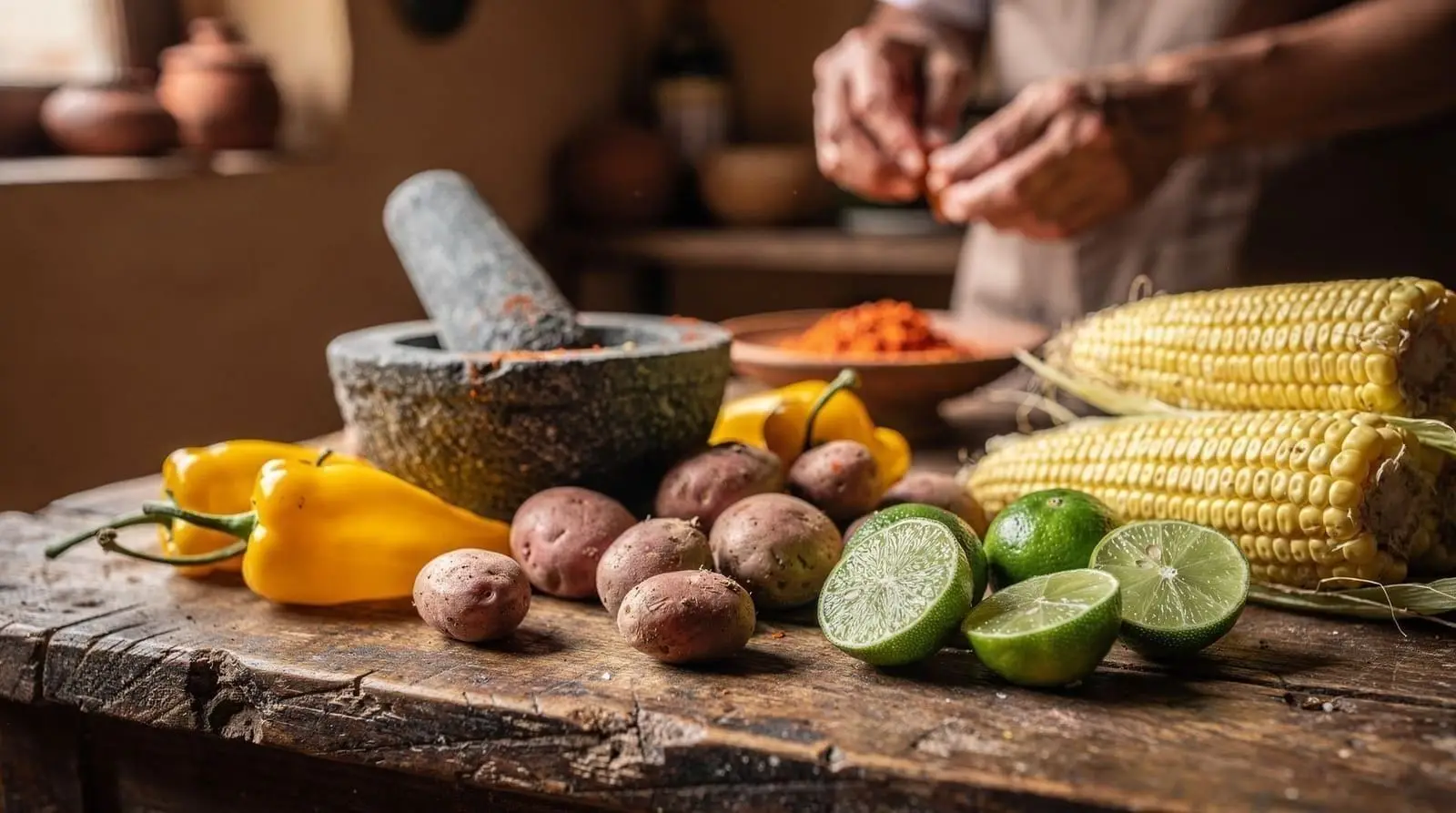
Cusco cooking classes compared: which one is worth your soles
Cusco: San Pedro Market and Peruvian Cooking Class
Are cooking classes in Cusco worth it?
Yes, if you pick the right format. Expect to pay S/130–260 (roughly $35–70) for a 3–4 hour class. The best value combines a guided San Pedro market walk with hands-on cooking of a pisco sour, ceviche and a main — book the market version early in your stay so you learn the produce before you read it on every menu.
What you are actually paying for
A cooking class is one of the few cultural activities in Cusco where the price spread does not track quality in a straight line. A S/250 class is not automatically twice as good as a S/130 one — what you are paying for is a specific bundle of things, and once you can see the parts, you can judge whether a given class is worth it for you.
The four variables that matter are the market visit, the group size, the number and type of dishes, and whether the pisco sour is included. A class that walks you through San Pedro market before cooking is doing real work for you: it teaches you to recognise the dozens of potato varieties, the ají chilies, the Andean cheeses and the fruit you have never seen, so that for the rest of your trip every menu reads clearly. A studio-only class skips that and gets you to the stove faster and cheaper.
This guide compares the formats honestly, with prices in soles and the dollar equivalent at roughly S/3.70 to the dollar, so you can pick the one that fits your day rather than the one with the loudest flyer.
| Cost | S/130–260 (about $35–70) per person |
| Time needed | 3 hours (studio) to 4.5 hours (market + cooking) |
| Where | Near San Pedro market or a nearby kitchen studio |
| Best time to book | Day 2–3 of your Cusco stay, before your palate is set |
| Booking window | A few days ahead in June–August; walk-up often fine off-season |
The three formats, ranked by what they deliver
Market tour plus full cooking class (the best all-rounder)
This is the format most first-time visitors should book, and it is the one I’d recommend doing early in a Cusco stay rather than late. You meet a guide at or near San Pedro market, spend 45–60 minutes walking the stalls with tastings of fruit, cheese and chocolate, then move to a nearby kitchen to cook a three-part meal — almost always a pisco sour, a cold starter (ceviche or causa limeña), and a hot main such as lomo saltado or ají de gallina. You eat what you make at the end.
Expect S/200–260 (about $54–70) for 4 to 4.5 hours. The San Pedro market tour and Peruvian cooking class is the cleanest example of this bundle: the market walk does the educational heavy lifting, and the kitchen session is genuinely hands-on rather than a demonstration you watch. If you only do one food activity in Cusco, this is the one with the longest tail of usefulness, because everything you learn at the stalls pays off at every restaurant afterwards.
A close alternative is the Peruvian cooking class and market tour, which runs the same market-then-kitchen structure with a slightly different dish rotation. Read the current dish list when you book — operators rotate between ceviche, causa and stuffed rocoto depending on the season and what’s fresh.
Studio-only cooking class (the budget-friendly shortcut)
If your schedule is tight, or you’ve already done a market walk on your own, the studio-only class strips out the market and starts at the stove. You still cook a pisco sour and a main, sometimes a starter, in about three hours. The trade-off is context: you cook with ingredients someone else selected, so you learn the recipes but not the produce.
This is the better-value pick on price. The 3-hour Peruvian cooking class typically runs S/130–170 (about $35–46) and is a good fit for travellers who want the cooking without a half-day commitment, or who are squeezing it in around a Sacred Valley day trip. Smaller groups here mean more hands-on time per dish.
The “free” street workshop (skip it)
Around the Plaza de Armas and along Calle Plateros, touts hand out flyers for “free” or near-free chocolate-making, pisco or cooking workshops. These are almost universally sales funnels: a short demonstration that ends in a hard push to buy products at marked-up prices. They are not real classes. If you want a transparent chocolate experience, the ChocoMuseo on Calle Garcilaso runs legitimate paid workshops with clear pricing. Treat anything unsolicited on the street with the same caution you’d apply to a “free” anything.
The three formats side by side
| Format | Price (S/) | Duration | Market walk | Best for |
|---|---|---|---|---|
| Market + cooking | 200–260 | 4–4.5 hrs | Yes | First Cusco food activity, longest payoff |
| Studio-only | 130–170 | ~3 hrs | No | Tight schedules, tighter budgets |
| ”Free” street workshop | 0 (then a hard sell) | 30–60 min pitch | No | Nobody — skip it |
A side-by-side on what matters
When you compare classes, line them up on these points rather than on the photos:
- Group size. Six to ten people is the sweet spot. Below that you pay more; above twelve you spend the class waiting your turn at a shared pan. Operators rarely publish caps, so message and ask.
- Dishes you physically cook. Some “classes” are demonstrations where the chef cooks and you watch, then eat. Confirm you’ll be at the stove for the main, not just the cocktail.
- Market included or not. Worth S/40–60 of the price difference if you’re early in your trip and haven’t yet learned the produce.
- Dietary swaps. Vegetarian and vegan versions (quinoa-stuffed rocoto, vegetable causa, mushroom lomo saltado) are standard — flag them at booking, not on the day.
- What you keep. Most classes send you home with the recipes by email. The pisco sour ratio and the lomo saltado technique are the two you’ll actually reuse.
Timing it within your Cusco days
The single best piece of scheduling advice: do the market-plus-cooking class on day two or three, not day five. The whole point of the San Pedro walk is to teach you what you’re looking at, and that knowledge compounds across every meal you eat afterward in Cusco and beyond. Doing it on your last afternoon wastes most of that value.
Avoid pairing a cooking class with a strenuous day. A class is a relaxed, indoor, food-and-pisco afternoon — pair it with a flat city wander, not a return from Rainbow Mountain. And remember the altitude rule on the pisco sour: alcohol bites harder at 3,400 m, so if you’re newly arrived, taste lightly.
For where to eat once the class has sharpened your palate, the best restaurants in Cusco guide covers the cuy specialists and novoandina kitchens, and the broader Peruvian food guide explains the dishes you’ll now recognise on every chalkboard menu. If you’re watching every sol, see Cusco on a budget for how a class fits a tighter daily spend.
The dishes you’ll actually cook, and why they matter
It helps to know the repertoire before you book, because the dish list tells you a lot about how good a class will be. The Cusco standard rotates through a small, well-chosen set of Peruvian classics, and a class that teaches you these genuinely sends you home able to recreate a Peruvian meal.
Pisco sour is the near-universal opener — Peru’s national cocktail, a frothy mix of pisco grape brandy, lime, simple syrup, egg white and a few drops of Angostura bitters. The technique worth learning is the dry shake then wet shake that builds the foam. It’s a five-minute lesson with a lifetime of use, and it’s why almost every class includes it.
Causa limeña is a layered cold dish of mashed yellow potato whipped with ají amarillo and lime, stacked with chicken or avocado. It’s a brilliant introduction to Peru’s potato obsession and ají chili culture, and it travels well — you can make it anywhere you can find a waxy potato and ají amarillo paste.
Ceviche is the headline coastal dish: raw fish “cooked” in lime juice with red onion, ají and cilantro, served with sweet potato and choclo (large-kernel Andean corn). A good instructor teaches you the leche de tigre (the citrus marinade) and the timing, since over-marinating turns the fish tough. It’s the hardest to replicate at home because it depends on very fresh fish.
Lomo saltado is the dish most students are happiest to take home — a stir-fry of beef, onion, tomato and ají amarillo, splashed with soy sauce and vinegar, served with both fries and rice. It’s the clearest example of chifa, the Chinese-Peruvian fusion that runs deep in the country’s cooking, and it reheats and reproduces beautifully in any kitchen.
Ají de gallina (shredded chicken in a creamy ají amarillo and walnut sauce) sometimes stands in for lomo saltado as the hot main. Either way, a class that teaches the ají amarillo base teaches you the flavour that underpins half of Peruvian cooking.
If a class advertises only a cocktail and “a main,” ask which main and whether you cook it yourself. The breadth and the hands-on factor are what separate a real class from a glorified tasting.
What separates a good instructor from a filler one
The operator’s photos won’t tell you this, so it’s worth knowing what to listen for. A strong cooking-class instructor does three things a weak one doesn’t: they explain the why behind each step (why you dry-shake the pisco sour first, why you salt the onion for ceviche), they let you actually do the knife work and the cooking rather than demonstrating while you watch, and they adapt to the group — slowing down for nervous cooks, pushing confident ones.
The warning signs of a filler class: a group so large you spend most of it queuing for a shared stove, pre-chopped or pre-cooked ingredients that reduce you to assembly, and a rushed pace that gets everyone fed and out the door. The market-tour versions tend to attract better instructors because the format itself is built around teaching, but group size is the variable that most often degrades the experience — which is why it’s the first question to ask.
Is a Lima class better value than a Cusco one?
If your trip starts in Lima, you might wonder whether to cook there instead. Both work, but they teach different things. Lima classes lean coastal — ceviche, tiraditos, the seafood end of Peruvian cooking — while Cusco classes lean Andean, with more potatoes, quinoa, ají and the highland take on lomo saltado. If you can only do one, do it where you’ll spend more days. For most southern Peru loops that’s split evenly, so the deciding factor is usually which city you reach with more energy and an open afternoon.
Walking San Pedro market without a class
If you decide a class isn’t worth the soles, you can still get much of the educational value by walking San Pedro market yourself, which costs nothing. The market is a working local market, not a tourist set-piece, and it’s the single best place in Cusco to understand what you’ll be eating.
A self-guided loop worth doing: start at the fruit section, where vendors hand out tastings of chirimoya, lúcuma, granadilla and aguaymanto; move through the potato and grain stalls to see the dozens of native potato varieties and the quinoa, kiwicha and tarwi; pause at the cheese and bread aisles; and finish at the cooked-food counters, where a caldo de gallina or a fresh juice costs S/6–10 and feeds you better than any plaza restaurant.
What you lose by going alone is the narration — knowing that the wrinkled black potato is freeze-dried chuño, or which of the ten ají varieties is the fiery rocoto. But if you’ve done a class elsewhere, or you’re a confident traveller, a self-guided market morning plus the recipes you find online gets you a surprising distance for free. It also pairs well with a tight Cusco budget, where every S/200 class is a meaningful share of the day.
Vegetarian, vegan and dietary swaps
Peruvian cooking translates well to plant-based versions, and Cusco operators have caught up. The standard swaps: quinoa or mushroom stands in for the meat in lomo saltado, causa is made with avocado instead of chicken or tuna, and stuffed rocoto goes vegetarian with quinoa and vegetables instead of the traditional meat filling. Ceviche is harder to substitute meaningfully — some classes offer a mushroom or hearts-of-palm version, others simply swap it for an extra vegetable dish.
The rule that saves disappointment: flag any dietary need when you book, not when you arrive, since instructors shop the morning’s ingredients around the group’s stated needs. Gluten-free is generally straightforward, as most of the core dishes (ceviche, causa, lomo saltado over rice) are naturally gluten-free once the class knows to skip soy sauce with wheat in it.
What a market-plus-cooking day actually looks like, hour by hour
Knowing the rhythm in advance helps you plan the rest of your day around it. A typical booking: 9:00–9:15 meet your guide near San Pedro market; 9:15–10:15 walk the stalls with tastings of fruit, cheese and chocolate, learning the produce as you go; 10:30–11:00 arrive at the kitchen, wash up and get your station; 11:00–12:30 cook the pisco sour, the cold starter and the hot main under the instructor’s guidance; 12:30–13:15 sit down and eat what you made, usually with a second pisco sour.
Studio-only classes compress this to a single 3-hour block starting straight at the stove. Either way, the class eats into your late morning and lunch, so plan a gentle activity — a wander of San Blas or a slow café — for the hour before, not a strenuous ruins visit.
Frequently asked questions about Cusco cooking classes compared: which one is worth your soles
How much does a cooking class in Cusco cost?
Do Cusco cooking classes include a market visit?
What dishes will I learn to cook?
Is the pisco sour part safe at altitude?
Should I book ahead or arrange it on arrival?
How long do the classes last?
Can I do a cooking class solo, or do I need a group?
Do cooking classes run in the rainy season?
Top experiences
Bookable activities with verified prices and instant confirmation on GetYourGuide.
