Vinicunca vs Palccoyo: which rainbow mountain to choose?
Vinicunca Rainbow Mountain Day Trip from Cusco
Should I visit Vinicunca or Palccoyo rainbow mountain?
Choose Vinicunca for the famous, vivid single ridge of stripes and the dramatic photo, accepting big crowds, a higher 5,000 m+ summit and a tougher hike. Choose Palccoyo for an easier, much quieter alternative with three colourful hillsides, a lower peak and a short walk — better for families, those worried about altitude, or anyone who wants the rainbow effect without the queues. Both are day trips from Cusco.
Two rainbow mountains, one decision
A decade ago almost no traveller had heard of a rainbow mountain near Cusco. Then the snow retreated from a ridge called Vinicunca, exposing bands of mineral-stained rock, and the photograph went around the world. Today it is one of Peru’s most visited day trips — and one of its most crowded and physically punishing. In response, a quieter alternative has risen: Palccoyo, a second set of striped hillsides reached by a far gentler walk. Faced with both, travellers ask the same question: which one should I actually do?
| Vinicunca | Palccoyo | |
|---|---|---|
| Altitude | ~5,000–5,200 m | ~4,900 m |
| Walk | 1.5–2 hrs uphill | 20–40 min near-flat |
| Crowds | Very heavy | Light |
| Best for | The iconic photo | Families, altitude caution |
| Rough price | S/90–150 | S/100–160 |
This guide answers it without the hype. Neither is objectively “better”; they suit different people. Vinicunca delivers the famous, concentrated image at the cost of crowds, a higher summit and a hard climb. Palccoyo trades a little drama for solitude, a short walk and a far more forgiving altitude profile. Below we compare them across the things that genuinely decide the choice — altitude and difficulty, crowds, colour, cost and logistics — so you can pick the one that fits your body, your group and your tolerance for queues. The broader “is it even worth it” question is tackled in is Rainbow Mountain worth it.
Altitude and difficulty: the biggest difference
This is where the two diverge most, and for many travellers it settles the decision on its own.
Vinicunca is high and hard. The viewpoint sits at roughly 5,000-5,200 m, and reaching it means a steep uphill hike of about 1.5-2 hours from the car park, climbing a few hundred metres at an elevation where every step is an effort. Even fit, acclimatised hikers feel it; the unacclimatised struggle badly, and a steady trade in horses ferries flagging visitors up the final stretch. It is a genuine high-altitude exertion, not a stroll.
Palccoyo is high but easy. The main viewpoint sits around 4,900 m — barely lower than Vinicunca — yet the walk from the car park is short and almost flat, typically 20-40 minutes on gentle terrain. The elevation is still real, but without the steep sustained climb your body copes far better. This single contrast — same altitude, vastly different effort — is the reason Palccoyo exists as an alternative.
The practical upshot: if anyone in your group is worried about altitude, unfit, older, or travelling with children, Palccoyo is the responsible choice. Vinicunca rewards those with the legs and lungs for it, but it is not a casual outing. Whichever you pick, both demand prior acclimatisation in Cusco or the Sacred Valley — never attempt either on your first days at altitude. See the altitude sickness guide before you go.
Crowds: the quiet case for Palccoyo
Vinicunca’s fame is also its biggest drawback. On a peak-season dry-day morning the trail can carry well over a thousand people, strung up the ridge in a near-continuous line, with a queue forming for the summit photo at the top. The early-morning start is partly an attempt to beat the worst of it, but the sheer volume of tour buses arriving means solitude is rarely on offer. For some the buzz is part of it; for many it undercuts the wilderness the photos imply.
Palccoyo is the antidote. It receives a small fraction of Vinicunca’s traffic, so you can often stand at the viewpoints with only your own group around you. If the crowds are what put you off rainbow mountains entirely, Palccoyo is very likely the version you actually want — the colour without the conga line.
Colour and scenery: drama vs variety
On pure spectacle, the two offer different things.
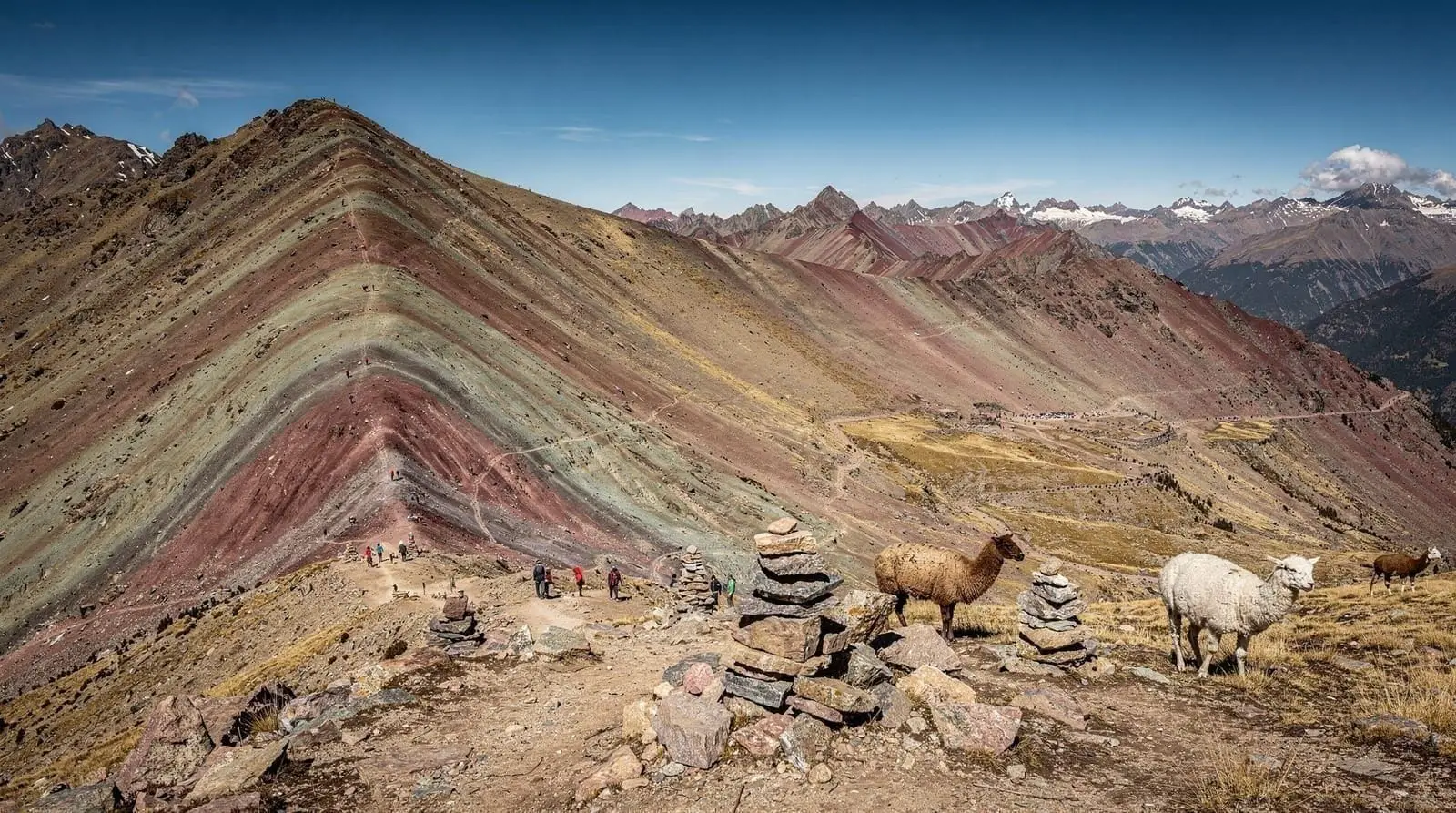
Vinicunca is the more striking single image. It is one dramatic, steep ridge banded in red, ochre, green, lavender and turquoise, with the snow-capped Ausangate massif behind it — the concentrated, postcard shot that made the phenomenon famous. When the light and weather cooperate, nothing else around Cusco matches that one frame.
Palccoyo spreads its colour more gently across three separate striped hillsides rather than one knife-edge ridge, and adds a bonus the bigger site lacks: a “stone forest” of tall rock spires near the viewpoints. The effect is more varied and more relaxed but less concentrated — you take in a colourful landscape rather than a single dramatic ridge.
A crucial caveat for both: the colours are mineral, not painted, and depend entirely on weather and light. A grey, overcast or snowy day washes out either mountain, and the wet-season months can bury the stripes under snow or cloud. Dry-season mornings (roughly May to September) give the best odds at both. Manage your expectations — the saturated images online are often enhanced, and reality on a flat-light day is more muted.
Cost and logistics
The two are similar in price and in shape of day, with Palccoyo marginally gentler overall.
Both are long day trips southeast of Cusco. Vinicunca is around 3-3.5 hours’ drive each way, with a pre-dawn pickup (often 3-4 am) to reach the trailhead and beat the crowds and afternoon weather. Add the 1.5-2 hour climb and the descent, and it is a long, demanding day, typically 12-14 hours door to door. Palccoyo is a touch closer at about 3 hours, and although the drive is comparable, the short flat walk makes the overall day notably less punishing — you are back in Cusco less wrecked.
Group day-tour prices for both sit in a similar band and usually include transport, a guide, breakfast and lunch, and the local entrance fee. As always in Cusco, the rock-bottom street-stall price is a warning sign rather than a bargain — a properly equipped operator with oxygen aboard matters on a 5,000 m outing, a point made at length in unlicensed tour agencies in Cusco.
To book, the Vinicunca Rainbow Mountain day trip from Cusco is the standard way to do the famous ridge with transport, guide and meals handled, while the full-day Palccoyo all-inclusive tour covers the quieter alternative with the same conveniences and a gentler walk. Both appear among the wider menu in best day trips from Cusco.
When to go, and what the day demands
Timing matters as much as the choice of mountain, because the colours and the comfort both hinge on weather. The dry season, roughly May to September, gives the most reliable clear mornings and the best-saturated rock, but it is also the busiest and the coldest — pre-dawn temperatures at the trailheads can sit below freezing. The shoulder months of April and October trade a little weather risk for thinner crowds. The wet season, November to March, frequently buries both mountains under fresh snow or hides them in cloud, and the unpaved access roads turn rough; it is the gamble period for both sites.
Either way, the day starts brutally early. A Vinicunca tour typically collects you from your Cusco hotel around 3 to 4 am to reach the trailhead by mid-morning, ahead of the worst crowds and the afternoon cloud build-up. Palccoyo’s pickup is a little more humane but still pre-dawn. Dress for the cold at the top and the warmth in the van: thermal layers, a windproof shell, a hat and gloves, sun protection for the fierce high-altitude UV, and proper shoes — Vinicunca’s climb in particular is no place for street trainers in mud or snow. Bring more water and a few snacks than you think you need, and small soles notes for the trailside toilets and the optional horse hire at Vinicunca.
A note on horses: at Vinicunca, local muleteers offer to carry you most of the way up for a negotiated fee, and there is no shame in taking one if the climb defeats you at altitude. The horses stop short of the final viewpoint, so the last stretch is always on foot. At Palccoyo the walk is short enough that horses are rarely needed. Build the full day into your Cusco plan as a write-off — between the driving and the altitude, you will not want to do anything strenuous afterwards.
So which should you choose?
A simple way to decide:
- Choose Vinicunca if the iconic single image is the whole point, you are well acclimatised and reasonably fit, and you can accept large crowds and a hard climb in exchange for the famous photo.
- Choose Palccoyo if you want the rainbow effect without the queues, you are travelling with children or older companions, you are unsure how you handle altitude, or you would rather enjoy a quiet, gentle outing than conquer a summit. Families should also see family-friendly day trips from Cusco.
There is no wrong answer — only the right one for your group. And if your acclimatisation is shaky or the forecast is poor on your only available day, Palccoyo is the lower-risk bet on every front.
Managing expectations about the colours
It is worth being blunt about this, because it is the single biggest source of disappointment at both mountains. The hyper-saturated images that fill social media are, more often than not, edited well beyond what your eyes see on the day. The stripes are genuine — bands of red iron oxides, yellow sulphides, green chlorite and so on, exposed as the glacier retreated — but their vividness depends entirely on the light and the weather at the moment you arrive. A bright, clear morning after dry weather shows strong colour; flat overcast light mutes it; fresh snow or cloud can hide it altogether.
This affects the two mountains slightly differently. Vinicunca’s drama is concentrated in one ridge, so a bad-light day there feels like a bigger letdown — you have made a hard climb for a washed-out version of the famous shot. Palccoyo’s gentler, spread-out colour and its bonus stone-forest scenery give you more to enjoy even when the rock is not at its most vivid, which is another quiet point in its favour for a single, weather-dependent visit. Either way, go in expecting a beautiful high-Andean landscape rather than a neon postcard, and you will leave satisfied. The wider honest assessment of whether the trip lives up to its reputation is in is Rainbow Mountain worth it.
What if neither quite fits?
A small share of travellers read this comparison and realise neither option is quite right — they want the colours but are put off by both Vinicunca’s crowds and Palccoyo’s slightly more subdued single-image drama. For them, Ausangate, further southeast, is worth a look: its own coloured slopes plus a seven-lakes circuit sit in far emptier terrain than either of the two mountains above, at the cost of a longer, harder day better suited to well-acclimatised travellers. It is not a direct substitute — think of it as the answer for travellers chasing solitude and raw scenery over a specific photograph.
Separately, if altitude is your main concern regardless of which coloured mountain you pick, Humantay Lake offers a different high-Andes day trip at a broadly comparable altitude with its own turquoise-glacial-lake reward, worth comparing if the “rainbow” concept itself is not the non-negotiable part of your day. None of these substitutions are second-best choices — they simply serve a different priority, whether that is solitude, a lower physical demand, or a different kind of high-Andes scenery entirely, and the honest answer for a lot of travellers is that the “best” rainbow mountain is the one that matches their fitness and tolerance for crowds rather than the one with the most famous name.
Booking either mountain
Whichever you choose, book a tour that bundles transport, breakfast, lunch and a guide rather than assembling the logistics yourself — the early starts and long drives make this one of the clearest cases in Peru for letting an operator handle the day. For the famous ridge:
Vinicunca Rainbow Mountain day trip from CuscoFor the gentler, quieter alternative:
Full-day Palccoyo all-inclusive tour