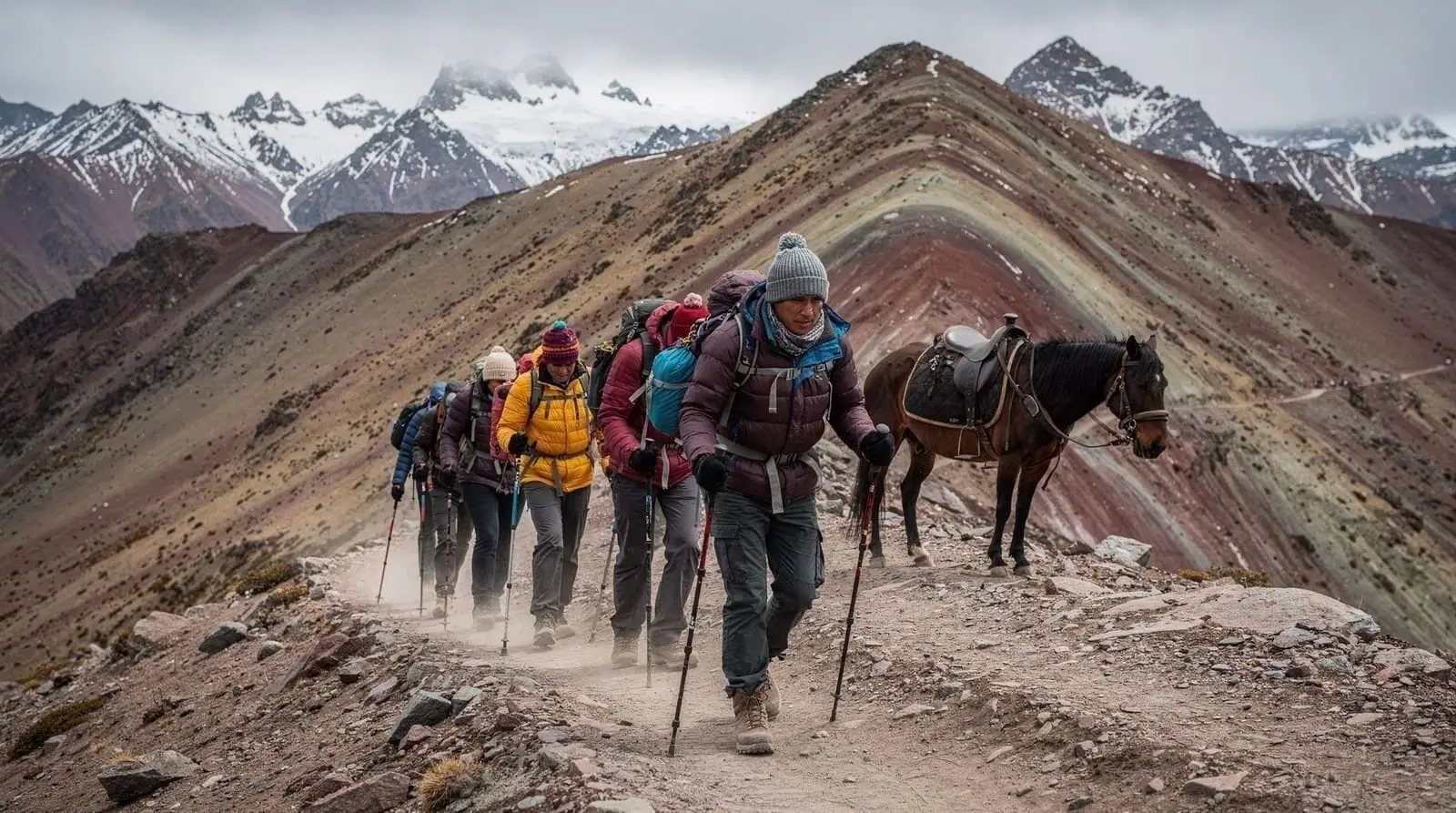
Rainbow Mountain altitude tips
Vinicunca Rainbow Mountain Day Trip from Cusco
How do I handle the altitude on Rainbow Mountain?
Spend at least two full days at Cusco altitude before Vinicunca's 5,036 m summit. Walk slowly, hydrate hard, skip alcohol the night before, and know the warning signs. If you get confusion, vomiting or a wet cough, descend immediately.
Why this is the most important page you’ll read about Vinicunca
Plenty of Rainbow Mountain articles treat altitude as a footnote. It is not a footnote — it is the single factor most likely to ruin your day or, in rare cases, put you in real danger. The Vinicunca viewpoint sits at roughly 5,036 m, with the trailhead already at about 4,600 m, which means you start walking at an elevation higher than almost anywhere most travellers have ever been. At that height there is around half the oxygen available at sea level. This guide is dedicated entirely to getting your body ready, recognising trouble, and knowing when to stop.
| Summit altitude | ~5,036 m (trailhead ~4,600 m) |
| Minimum acclimatisation | 2 full days at Cusco altitude; 3 is better |
| Key warning signs | Vomiting, confusion, wet cough — descend immediately |
| Helpful, not sufficient | Coca tea/leaves for mild symptoms |
| Gentler alternative | Palccoyo (~4,900 m, near-flat walk) |
If you only remember one thing, remember this: acclimatisation is not optional, and no amount of fitness substitutes for it. The full logistics, costs and route are in the Rainbow Mountain complete guide; this page is about staying well enough to enjoy it.
Understand what your body is dealing with
Altitude affects everyone, regardless of age or fitness. As you climb, the air pressure drops and each breath delivers less oxygen to your blood. Your body responds by breathing faster and producing more red blood cells, but that adaptation takes days, not hours. Acute mountain sickness (AMS) is what happens when you ascend faster than your body can adjust: headaches, nausea, dizziness and fatigue. At Vinicunca’s elevation, even well-acclimatised people feel the thin air; the goal is to keep it at “uncomfortable” rather than “dangerous.”
Two rarer but serious conditions matter too. High-altitude pulmonary edema (HAPE) is fluid in the lungs, signalled by a wet cough and breathlessness at rest. High-altitude cerebral edema (HACE) is fluid on the brain, signalled by confusion and loss of coordination. Both are medical emergencies whose only reliable treatment is immediate descent.
| Symptom level | What you feel | What to do |
|---|---|---|
| Normal | Mild headache, breathlessness, fatigue | Slow down, hydrate, keep going |
| Concerning | Worsening headache, nausea, dizziness | Rest, drink water, consider turning back |
| Emergency | Vomiting, confusion, wet cough, can’t walk straight | Descend immediately, seek help |
The acclimatisation timeline
This is where most Rainbow Mountain problems begin and end.
- Minimum: two full days at Cusco altitude (3,400 m) or in the Sacred Valley before attempting Vinicunca.
- Better: three or more days, ideally including a moderate high-altitude warm-up such as a Sacred Valley site or a gentler hike first.
- Never: fly into Cusco one evening and book Rainbow Mountain for the next morning. This is the most common cause of travellers needing oxygen at the trailhead.
A useful trick is to sleep lower than you climb. Because the Sacred Valley sits around 2,800-2,900 m — lower than Cusco — spending early nights there and doing your sightseeing at Cusco’s height eases the adjustment. For a structured plan, the Cusco acclimatization plan lays out a day-by-day schedule, and the altitude sickness in Cusco guide covers the general picture.
Practical defences that actually work
- Hydrate aggressively. Drink far more water than feels natural — the dry mountain air dehydrates you fast, and dehydration worsens altitude symptoms. Aim for several litres a day in the build-up.
- Skip alcohol the night before, and go easy on heavy food. Both make symptoms worse. A light, carbohydrate-leaning dinner is better than a big meal.
- Use coca. Chewing coca leaves or drinking mate de coca (coca tea) is the traditional Andean remedy and genuinely eases mild headaches and fatigue for many people. It is legal and available everywhere in Peru. See coca tea and altitude remedies for how to use it.
- Consider Diamox — with a doctor. Acetazolamide (Diamox) can help prevent AMS when started a day or two before ascent, but it is a prescription drug with side effects (tingling, frequent urination, altered taste). Arrange it with a doctor before your trip, never at the trailhead.
- Walk at a llama’s pace. On the hike itself, go slowly and deliberately: a few steps, a breath, repeat. There is no prize for arriving first, and pushing hard is exactly how AMS escalates.
Be wary of “miracle” altitude pills, oxygen-in-a-can stalls and pharmacies pushing unnecessary drugs in Cusco — the altitude medicine scams in Cusco guide covers what to avoid.
What to pack for the cold and the sun
Vinicunca’s weather is brutal and changeable. The trailhead can be sunny and mild while the summit, 45 minutes higher, is in freezing wind and sleet. Dress for winter even in the dry season:
- Warm base layers plus an insulating mid-layer.
- A windproof, waterproof outer jacket.
- Gloves, a warm hat, and a buff or scarf for the wind.
- Strong sunscreen and lip balm — UV at 5,000 m is severe even through cloud — plus sunglasses.
- Sturdy shoes with grip for loose gravel, and trekking poles for the descent.
- Water, high-energy snacks, cash for the entry fee and toilets, and any altitude medication.
A small daypack covers all of this. Avoid overpacking, since carrying weight uphill at altitude is its own penalty.
Knowing when to turn back
This is the part that takes discipline. Mild headache, breathlessness and tiredness are normal at this elevation and usually manageable with slow walking, water and rest. The signs that mean stop and descend are different and unambiguous: persistent vomiting, confusion or strange behaviour, an inability to walk in a straight line, or a wet, bubbling cough. These point to HACE or HAPE, and the only reliable treatment is going down — fast.
A reputable operator carries an oxygen bottle and a guide trained to watch for these signs, which is one more reason to choose a smaller-group, slightly more expensive tour over the cheapest quote. There is no shame in taking a horse for the ascent, turning around early, or skipping the final stretch. The mountain will be there next time; a serious altitude emergency at 5,000 m is genuinely dangerous.
Building altitude before you arrive
Acclimatisation does not have to start in Cusco. If your itinerary allows, arriving in Peru via a mid-altitude stop helps. Some travellers spend a night or two in Arequipa (about 2,300 m) or the Colca area before flying to Cusco, which softens the jump from sea level. Within the Cusco region, the smartest sequence is to spend your first nights lower in the Sacred Valley (around 2,800-2,900 m) while sightseeing at Cusco’s height during the day, then return to Cusco, and only attempt Vinicunca once you have several days of gradual exposure behind you.
Doing a moderate high-altitude outing first — a Sacred Valley site, Maras-Moray, or a gentler hike — acts as a useful test of how your body is coping before you commit to nearly 5,000 m. If you struggle at 3,500 m, that is valuable information to have before the 3 am alarm rather than at the trailhead.
Who should think twice
Altitude does not discriminate by fitness, but some travellers carry extra risk and should weigh Vinicunca carefully or choose Palccoyo instead. Anyone with significant heart or lung conditions, uncontrolled high blood pressure, or a previous serious episode of altitude sickness should consult a doctor before attempting an outing above 5,000 m. Pregnant travellers are generally advised to avoid extreme altitude.
Very young children struggle to communicate symptoms and are harder to assess, which is why many families opt for the lower, gentler Palccoyo. None of this is a blanket ban — plenty of older and less athletic travellers do Vinicunca successfully after careful acclimatisation — but it is a reason to be honest with yourself and, where relevant, with a medical professional before you book.
When to choose Palccoyo instead
If your schedule cannot accommodate two or three acclimatisation days, if you are travelling with young children, or if any of the above makes you uneasy, the honest move is to swap Vinicunca for Palccoyo. It sits a little lower (around 4,900 m), the walk is a near-flat 30-45 minutes rather than a sustained climb, and it offers three rainbow ridges with far fewer people.
The full-day Palccoyo Rainbow Mountain tour is the standard way to do it, and for many travellers it is simply the smarter, safer choice. Either way, the iconic version is the Vinicunca Rainbow Mountain day trip from Cusco — just go into it acclimatised.
On the day itself: a sensible routine
Good acclimatisation can still be undone by a careless morning, so the day of the hike has its own rhythm. Eat a light breakfast at the tour’s stop even if the early hour kills your appetite — your body needs fuel at altitude. Sip water steadily throughout the drive and the walk rather than gulping it all at once. When you start the hike, go slowly from the very first step; the temptation to keep pace with the group is exactly what triggers symptoms.
Layer up before you reach the cold summit rather than waiting until you are shivering, since being cold adds stress your body does not need up here. If you feel a headache building, stop, breathe, drink, and let it settle before continuing — pushing through is the wrong instinct. And take the horse, or turn back, the moment your body tells you to. The single most useful altitude skill is the willingness to stop, and there is no shame in using it.
After the hike
Recovery matters too. The descent and the long drive home leave most people drained, and the altitude has been working on your body all day. Keep drinking water on the way back, eat a proper meal at the lunch stop, and plan a quiet evening rather than a big night out in Cusco. If a headache or nausea lingers well into the evening or worsens, treat it seriously rather than assuming it will pass — persistent or worsening symptoms after descending to Cusco’s height still warrant attention. Avoid scheduling another demanding high-altitude activity for the following day; give your body a lighter day to consolidate the effort. Done sensibly, most travellers feel fine by the next morning, tired but without lasting effects.
Travel insurance and altitude
Because a genuine altitude emergency at nearly 5,000 m can mean evacuation costs, confirm before you travel that your insurance covers high-altitude trekking and, ideally, emergency evacuation from remote areas. Not all standard policies do, and some specifically exclude altitudes above a set threshold, so check the fine print rather than assuming. Carry your policy details and an emergency contact number with you on the day, since a reputable tour operator will ask for this information as standard practice before setting out, and it saves critical time if something does go wrong.
What a reputable operator does differently
The gap between a good and a mediocre Rainbow Mountain operator often comes down to how they handle altitude, not how comfortable the van is. A reputable guide watches the group continuously for the warning signs above, carries oxygen and a basic first-aid kit, sets a genuinely slow pace rather than rushing to beat a schedule, and will calmly recommend that a struggling traveller turn back or take a horse rather than pushing them onward for the sake of the itinerary. If you notice a guide ignoring visibly struggling clients, pushing the pace, or having no emergency plan, that is a legitimate reason to flag it, and it is worth choosing an operator with a track record on this specific point rather than picking on price alone.
The honest verdict
Frequently asked questions about Rainbow Mountain altitude tips
How high is Rainbow Mountain and why does altitude matter so much?
How many days should I acclimatise before Rainbow Mountain?
Does coca tea actually help with altitude?
Should I take Diamox for Rainbow Mountain?
What are the warning signs I should turn back?
What should I pack for the altitude and cold?
Does prior high-altitude experience elsewhere help at Rainbow Mountain?
Is altitude sickness medicine available in Cusco if I need it last minute?
Top experiences
Bookable activities with verified prices and instant confirmation on GetYourGuide.

