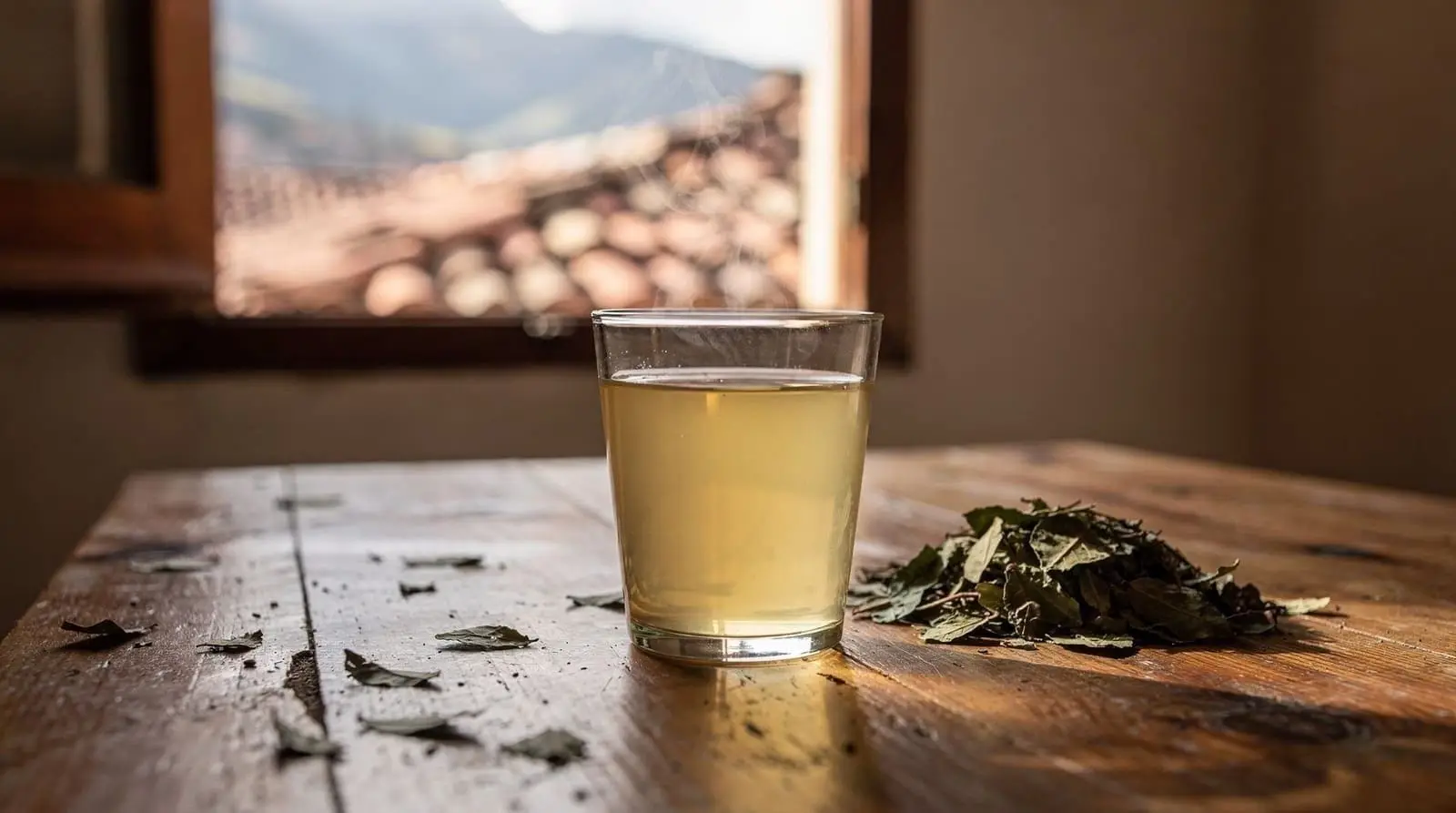
Coca tea and altitude remedies: what helps, what's myth
Does coca tea cure altitude sickness, and what actually works?
No remedy cures altitude sickness — only time, slow ascent, and hydration reliably help. Coca tea (mate de coca) eases mild symptoms modestly and is legal and normal in Peru, but it is not a substitute for acclimatising. Acetazolamide (Diamox), taken on medical advice, is the one drug with strong evidence. Note coca can trigger a positive cocaine drug test for days.
Sorting the folk wisdom from the physiology
Walk into almost any Cusco hotel and a thermos of mate de coca — coca-leaf tea — is waiting in the lobby, offered free as a welcome and a remedy. By the end of a day you will have been told that coca cures altitude sickness, that oxygen cans fix it, that a certain herbal pill works wonders, and that you should chew leaves on the trail. Some of this is true, some is harmless folklore, and a couple of points are genuinely important for your health and even your legal standing back home.
This guide is deliberately factual and non-promotional. Coca is a normal part of Andean life and there is no reason to treat it as exotic or alarming, but there is also no reason to overstate what it does. The honest summary is that no remedy cures altitude sickness — only slow ascent, time, and hydration reliably help — and everything else ranges from mildly useful to placebo. For the full mechanics of acclimatising, read this alongside our altitude sickness guide and the day-by-day Cusco acclimatisation plan.
| Where | Offered in nearly every Cusco hotel lobby, free |
| Cost | Free-S/5 for tea; pharmacy remedies a few soles |
| Legal status | Legal in Peru; coca products illegal to export |
| Drug test risk | Positive for 1-several days after use |
| What actually helps | Slow ascent, hydration, rest, time |
What altitude actually does to you
At Cusco’s 3,400 m the air holds roughly 35 percent less oxygen than at sea level; by Lake Titicaca at 3,800 m and on Rainbow Mountain above 5,000 m, the deficit is greater still. Your body responds by breathing faster and, over days, producing more red blood cells — but that adaptation takes time, and until it happens you may get soroche: headache, nausea, breathlessness, dizziness, and broken sleep.
Two facts shape everything that follows. First, soroche is unrelated to fitness — marathon runners get it, sedentary travellers sometimes sail through, and it is largely unpredictable. Second, the only treatments that address the actual cause are time and lower elevation. Remedies can ease symptoms while your body catches up, but none speeds up the underlying adaptation in any meaningful way. Keep that hierarchy in mind: remedies are comfort, not cure.
Coca tea: what it is and what it does
Coca has been chewed and brewed in the Andes for thousands of years. The leaf is woven into daily life, ritual, and work, and it is fully legal in Peru. Crucially, the leaf is not the drug: it contains only trace alkaloids, and turning it into cocaine requires industrial chemical processing. Drinking mate de coca will not intoxicate you.
What it does, modestly:
- Mild symptom relief. The leaf has mild stimulant and digestive properties that can take a small edge off a headache, settle a queasy stomach, and counter fatigue. Many travellers find a cup genuinely soothing.
- Hydration, indirectly. Because it is a warm drink you sip through the day, it nudges you to take in fluid — and dehydration worsens altitude symptoms, so anything that keeps you drinking helps.
What it does not do is replace acclimatisation. There is no good evidence that coca prevents or cures acute mountain sickness; it is a comfort measure, on a par with a warm cup of any soothing tea plus a faint pick-me-up. Drink it if you enjoy it — most people do — but do not let a thermos of coca tea tempt you into charging up a staircase on arrival day. The forms you will meet: the brewed tea (free in most lobbies, sold as tea bags everywhere), chewed leaves with a pinch of alkaline catalyst (llipta), and coca sweets and candies sold for the trail.
Coca’s cultural place — and why it deserves respect
It is worth pausing on the cultural side, because treating coca purely as a tourist remedy misses most of what it is. In the Andes the leaf is sacred and social: offered to Pachamama (Mother Earth) in rituals, exchanged as a sign of respect between people, chewed by farmers and porters through long working days, and read by traditional healers. The Inca state controlled coca as a ritual and elite substance; today it remains woven into highland life from the Sacred Valley to Lake Titicaca.
If you are offered leaves to chew rather than tea, the method is simple: tuck a small wad of leaves between cheek and gum — do not chew them to a pulp — and add a tiny pinch of llipta, an alkaline catalyst (often plant ash) that releases the leaf’s mild active compounds. The cheek goes slightly numb, and a faint, grassy energy follows. Trekking porters on the Inca Trail and Salkantay route use it exactly this way to blunt fatigue and hunger at altitude. Accepting an offer of coca graciously, when extended by a local, is a small courtesy that travels well.
None of this changes the physiology — the cultural significance and the modest medical effect are separate things — but it does explain why the thermos in your hotel lobby is more than a gimmick.
The two warnings that matter
This is the part to read carefully, because it concerns more than comfort.
1. Coca can make you fail a drug test. Drinking coca tea or chewing leaves can produce a positive urine test for cocaine metabolites (benzoylecgonine) for one to several days afterward. If your job, sport, or re-entry involves any chance of drug testing, avoid all coca products for your whole trip — the trace exposure is real even though you are not impaired in any way.
2. Do not take coca home. Coca leaves and most coca products are controlled or banned in nearly every country outside the Andes, including the US, UK, and EU, regardless of being legal in Peru. Coca tea bags are sold as souvenirs all over Cusco, but carrying them across a border can mean confiscation at best and a serious problem at worst. Leave them in Peru.
The remedies sold to tourists, ranked by evidence
Cusco’s pharmacies and souvenir shops sell a spectrum of altitude products. Here is an honest ranking by how much they actually help — and for the outright cons, our altitude medicine scams guide names the worst offenders.
Strong evidence:
- Acetazolamide (Diamox). The one drug with solid science behind it for preventing and easing acute mountain sickness. It is a prescription medication, taken starting a day before ascent, and it works by speeding the blood-chemistry adjustment. Get it and dosing advice from a doctor at home rather than buying it over the counter on arrival; it has side effects (tingling fingers, frequent urination, a metallic taste with fizzy drinks) and is not for everyone, including people with sulfa allergies.
Mild or short-lived help:
- Coca tea and leaves. Modest symptom relief, as above.
- Oxygen canisters. The cans sold in pharmacies give a brief lift against breathlessness but the effect fades within minutes; useful as momentary comfort, useless as treatment.
- Ibuprofen or paracetamol. Genuinely helps the altitude headache, which is often the most miserable symptom.
- Sorojchi-type pills. Over-the-counter combinations (often aspirin, caffeine, and salophen) that take the edge off a headache but do nothing for the underlying problem.
Placebo or marketing:
- “Altitude” herbal blends, oxygen-infused water, muña tea miracle claims. Muña (Andean mint) tea is pleasant and aids digestion, but claims that any herbal product prevents soroche are unsupported. Treat aggressive sales pitches with scepticism.
For a quick comparison, here is the same ranking as a table:
| Remedy | Evidence level | What it actually does |
|---|---|---|
| Acetazolamide (Diamox) | Strong | Speeds blood-chemistry adjustment; needs a prescription |
| Slow ascent / rest days | Strong (not a “product”) | Addresses the actual cause |
| Coca tea / leaves | Mild | Modest symptom relief, mild stimulant |
| Ibuprofen / paracetamol | Mild-moderate | Eases the altitude headache specifically |
| Oxygen canisters | Mild, brief | Temporary relief from breathlessness only |
| Sorojchi-type pills | Mild | Headache relief via aspirin/caffeine blend |
| Herbal “altitude” blends | None demonstrated | Marketing, not medicine |
A sensible arrival-day kit
If you want to walk into a Cusco pharmacy and buy the few things genuinely worth having, this is a short, honest shopping list — none of it a miracle, all of it useful:
- Ibuprofen or paracetamol for the altitude headache, which is usually the worst single symptom and responds well to ordinary painkillers.
- Oral rehydration sachets to make hydration count, especially if nausea is putting you off plain water.
- Acetazolamide (Diamox) only if a doctor at home prescribed it before you travelled — not an impulse over-the-counter buy on arrival.
- An anti-nausea tablet if you are prone to it; soroche nausea is miserable on a first night.
Skip the heavily marketed “altitude formula” blends and oxygen-infused waters; they add cost without adding much benefit. The thermos of coca tea in your lobby is free and as effective as most of what is for sale. The expensive end of the souvenir-shop altitude shelf is, with the single exception of prescription Diamox, the part to ignore — a point our altitude medicine scams guide makes in detail.
A note on travelling with children and older relatives: the same rules apply but with a lower threshold for caution. Children cannot always describe symptoms, and confusion or unusual drowsiness in a child at altitude should be taken seriously and fast. Anyone with heart or lung conditions should clear the trip with a doctor before booking high-altitude days.
What actually works: the boring, effective list
If you strip away the products, the things that reliably help are unglamorous and mostly free:
- Ascend slowly. The single most effective measure. Where your schedule allows, sleep a night or two lower in the Sacred Valley (Urubamba 2,870 m, Ollantaytambo 2,790 m) before coming up to Cusco — the altitude trade-off guide explains the logic.
- Rest on arrival day. No strenuous walking, no climbing, nothing ambitious for the first 24 hours.
- Hydrate hard. Three or more litres of water a day; dehydration mimics and worsens symptoms.
- Skip alcohol for the first day or two — a pisco sour on night one is the classic mistake.
- Eat light. Heavy meals divert oxygen-hungry blood to digestion.
- Sleep. Poor sleep is both a symptom and an aggravator; an easy first day helps you rest.
This is the real toolkit. Coca tea fits in as a pleasant accompaniment to the list, not a replacement for any item on it. For a structured version mapped to your first three days, follow the Cusco acclimatisation plan.
Knowing when it is no longer a comfort problem
The remedies above are for ordinary, self-limiting soroche. Some symptoms are not in that category and no tea or pill addresses them:
- Confusion, drowsiness, or loss of coordination (cannot walk a straight line) — warning signs of high-altitude cerebral edema (HACE).
- A wet, bubbling, or persistent cough, breathlessness at rest, or a blue tinge to lips — warning signs of high-altitude pulmonary edema (HAPE).
Both are medical emergencies. The treatment is immediate descent and medical attention, not another cup of coca tea. These severe forms are rare, but they are real, and the time people lose pretending an emergency is “just the altitude” is exactly the danger. Pharmacies on Avenida El Sol sell oxygen and several clinics provide oxygen on call to hotels, but a deteriorating patient needs descent and a doctor.
For planning ascents sensibly across a whole trip — Cusco, the valley, Titicaca, the high passes — the routings at /itineraries/ and the trip tools at /tools/ help you sequence elevation so your body keeps up.
Coca products you will actually be offered
Beyond the lobby thermos, coca shows up in a few forms worth recognising so you know what you are accepting:
- Mate de coca (tea bags or loose leaf) — the most common form, usually free at hotels and restaurants, mild and pleasant.
- Coca candies and chocolate-covered leaves — sold in markets as a novelty; same trace effect, sweeter delivery.
- Coca chewed with llipta — the traditional form, more common among locals and porters than tourists, with a stronger and longer-lasting mild effect than tea.
- Coca-based liqueurs or cocktails — occasionally offered in bars; a curiosity rather than an altitude remedy, and best treated as a normal drink, not medicine.
All of them carry the same drug-test caveat above, regardless of how mild or ceremonial the format feels.