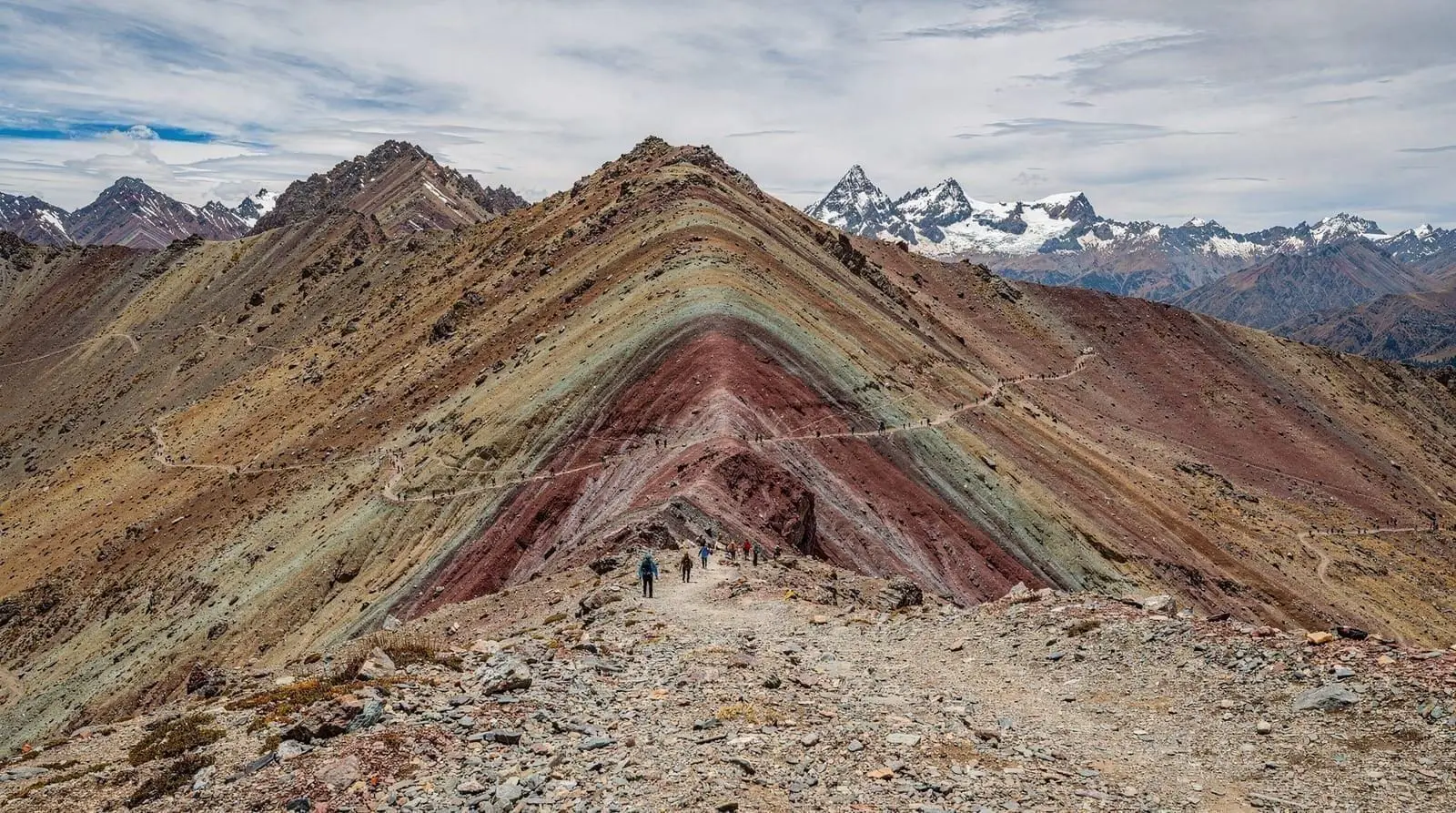
Rainbow Mountain complete guide
Vinicunca Rainbow Mountain Day Trip from Cusco
What do I most need to know about Rainbow Mountain?
Rainbow Mountain (Vinicunca) tops out at 5,036-5,200 m, three hours southeast of Cusco. Tours leave at 3-4 am, the round trip runs 14-16 hours, and the hike is 5-7 km. Acclimatise at least two full days in Cusco first or you risk altitude sickness.
A clear-eyed overview before you commit
Rainbow Mountain, known locally as Vinicunca and sold everywhere as the “Mountain of Seven Colours,” has gone from invisible to one of the most-photographed sights in Peru in barely a decade. The striped ridge of red, ochre, green and lilac is real, and on a clear morning with the snow melted off it is genuinely arresting. But this is not a casual outing. The viewpoint sits above 5,000 metres, the day starts in the dark, and the hike punishes anyone who has not given their body time to adjust. This guide walks through everything that matters — geology, logistics, money, crowds, fitness and the honest verdict — so you can decide whether Vinicunca belongs on your itinerary or whether a gentler alternative suits you better.
| Where | Cordillera Vilcanota, ~3hrs southeast of Cusco |
| Altitude | 5,036-5,200 m (trailhead ~4,600 m) |
| Cost | S/60-300 depending on tier, plus S/25 entry |
| Time needed | 14-16 hour day trip |
| Best time | April-October (dry season) for clear colours |
If you want a faster decision tree, the short version is this: do it only if you have at least two full days at Cusco altitude behind you, you are happy with a 3 am alarm and a 14-hour day, and you specifically want the iconic single striped ridge. Otherwise, read the comparison with Palccoyo near the end.
What Vinicunca actually is
Vinicunca (also spelled Winikunka) is a high ridge in the Cordillera Vilcanota, southeast of Cusco within land farmed by the communities of Pitumarca and Cusipata. The bands of colour come from mineral sediments laid down over millions of years and then tilted upward by tectonic forces: iron oxides produce the rust-reds and pinks, chlorite gives the greenish streaks, and sulphur and other compounds account for the yellows and creams.
The uncomfortable backstory is that the ridge was hidden under snow and glacier ice until quite recently. As the climate warmed and the ice retreated around 2015, the colours emerged, locals began guiding visitors, and within a few years it became a mass-tourism site. That history explains a lot about the visit today: the infrastructure is community-built and improvised, the trail is eroded and dusty, and the whole experience is more commercial than the pristine-wilderness photos suggest. None of that makes it not worth doing — it just means you should arrive with realistic expectations.
For the wider geography and how Vinicunca fits the Cusco-Andes region, the Rainbow Mountain (Vinicunca) destination page covers the surrounding area in more depth.
The full day, hour by hour
A standard Rainbow Mountain day trip is dominated by driving. Here is the realistic shape of it from Cusco:
- 3:00-4:30 am — hotel pickup in Cusco. The pre-dawn start is to beat the crowds and the afternoon cloud build-up.
- 5:30-6:00 am — breakfast stop in a roadside community, usually Cusipata or Pitumarca. Basic but hot.
- 8:00-8:30 am — arrive at the trailhead at roughly 4,600 m.
- 8:30-10:00 am — hike up. Short in distance, slow because of the altitude.
- 10:00-10:45 am — time at the viewpoint for photos.
- 11:00 am-1:00 pm — descend and drive to lunch.
- 5:00-7:00 pm — back in Cusco.
That is 14 to 16 hours door to door for around 45 minutes at the actual viewpoint. Knowing that ratio in advance prevents disappointment. Most travellers book a guided group trip such as the Vinicunca Rainbow Mountain day trip from Cusco, which bundles the pre-dawn transport, breakfast, a guide and the long drive home — logistics that are awkward to assemble independently because there is no public transport to the trailhead.
The hike itself
The walking distance is short, which fools people. The challenge is never the kilometres; it is the oxygen. At 4,800-5,000 m there is roughly half the air available at sea level, so a gentle slope feels like a staircase. The trail climbs steadily on a wide dirt path, gaining about 350-400 m over 2.5-3.5 km depending on where the vehicles park that day (parking moves as the access road is extended).
Walk at what Andean guides call “paso de llama,” a llama’s pace: a few steps, a breath, repeat. There is no reward for arriving first, and pushing hard up here is exactly how altitude sickness starts. Reasonably fit, acclimatised people reach the top in 90 minutes to two hours. The descent takes about an hour, but loose gravel makes trekking poles genuinely useful.
At the trailhead, local wranglers offer horses for the ascent, typically S/80-120 (about $22-32) one way and negotiable. It is a legitimate option if altitude is overwhelming you, and the fee supports the host communities. Horses cannot reach the final viewpoint, though — there is a steep last stretch of 10-15 minutes you must walk on foot. Decide honestly at the bottom rather than stalling halfway up.
For a deeper breakdown of acclimatisation, symptoms and what to pack, see the dedicated Rainbow Mountain altitude tips guide.
What it costs
Prices vary widely, and the cheapest tours cut corners. Here is the realistic picture for 2026:
- Budget group day trip: S/60-120 (about $16-32). Large groups, older minibuses, and the S/25 community entry fee often excluded.
- Mid-range / small group: S/150-300 (about $40-80). Smaller groups, better vehicles, fewer people per guide, usually breakfast and lunch included.
- Community entry ticket: around S/25 (about $7), sometimes included, sometimes payable in cash at the gate. Confirm before booking.
- Optional extras: horse S/80-120 one way; trailhead toilets a small coin fee; snacks and water from community vendors at fair, marked-up prices.
A very cheap quote almost always means a bigger group and a longer day, and sometimes a guide who does not carry oxygen. Spending a little more on a smaller-group operator is one of the better-value upgrades on this whole trip.
Crowds, season and conditions
Rainbow Mountain is busy. On a typical dry-season morning, hundreds of people share the viewpoint and queue for the same photo angle. The only reliable way to soften this is timing: the earliest tours that top out by around 9 am beat the worst of it, and weekdays are quieter than weekends.
Season matters even more for the colours themselves. April to October, the Andean dry season, gives the firmest trail and the most reliable striping. The January-to-March rainy season frequently blankets the ridge in snow or cloud — hiding the colours you came for — and turns the path to mud. If your trip falls in the wet months and Vinicunca is a must, build in flexible days so you can pick a clear-ish morning.
What to wear and pack
Vinicunca’s weather is severe and changes within minutes. The trailhead can be sunny and mild while the summit, less than an hour higher, is in freezing wind and sleet. Pack as though for a winter day even in the dry season:
- Warm base layers plus an insulating mid-layer, topped by a windproof, waterproof jacket.
- Gloves, a warm hat, and a buff or scarf against the wind.
- Strong sunscreen, lip balm and sunglasses — UV at 5,000 m is harsh even through cloud.
- Sturdy shoes with grip for loose gravel, and trekking poles, which earn their keep on the descent.
- A daypack with water, high-energy snacks, cash for the entry fee and toilets, and any altitude medication you have arranged.
Avoid overpacking. Carrying weight uphill at this altitude is its own penalty, and most of what you need fits in a small daypack. Leave anything non-essential in the van.
Food, toilets and what’s on the trail
Facilities are basic and community-run. Tours include a breakfast stop on the way and a lunch stop afterward, both at simple roadside restaurants in Cusipata or Pitumarca. On the mountain itself, community vendors sell water, snacks and hot drinks at marked-up but fair prices along the lower trail; carry small soles for these. There are rudimentary toilets at the trailhead for a small coin fee, and almost nothing once you start climbing, so plan accordingly. None of this is luxurious, but it is functional — the point is to arrive knowing it is improvised infrastructure on community land, not a developed national-park setup.
Photography and timing for the colours
If photographs are your main motivation, two factors decide your results: light and weather. The colours read best under clear skies with the sun reasonably high, which is part of why early-but-not-too-early arrivals do well — you want to beat the crowds but also have enough light on the ridge. Overcast conditions mute the striping, and fresh snow can hide it entirely. The dry season gives you the best odds. For the cleanest shots without a wall of people in frame, aim to reach the viewpoint among the first arrivals and walk slightly beyond the main crush, where the angles open up. A polarising filter helps cut the high-altitude haze and deepen the mineral tones.
How Rainbow Mountain compares to Palccoyo and Ausangate
Three different sights are all marketed under the “rainbow” banner, and picking the right one prevents a lot of regret:
- Vinicunca (this guide): the famous one. Highest, busiest, most photographed, hardest hike. Best for acclimatised travellers who specifically want the iconic single striped ridge.
- Palccoyo: the gentle alternative. Lower (around 4,900 m), a near-flat 30-45 minute walk, three rainbow ridges instead of one, and far fewer people. The honest pick if you are short on acclimatisation or wary of extreme altitude. The full-day Palccoyo Rainbow Mountain tour is the standard way to do it.
- Ausangate: the serious one. A multi-day trek, or a long day to the seven lagoons, around Peru’s holiest mountain — far less travelled, for hikers who want wilderness rather than a photo stop.
If Vinicunca is on your list mainly because it is famous, look hard at Palccoyo before you set that 3 am alarm. The decision often comes down to one honest question: do you want the specific image you have seen online, or do you want a good morning in the high Andes? If it is the former, Vinicunca it is. If it is the latter, Palccoyo will likely serve you better and cost you far less suffering.
| Vinicunca | Palccoyo | Ausangate | |
|---|---|---|---|
| Altitude | ~5,036 m | ~4,900 m | Multi-day trek, higher passes |
| Walk | 5-7 km, steady climb | Near-flat 30-45 min | Multi-day or long day hike |
| Crowds | Heavy | Light | Very light |
| Best for | The iconic photo | Gentler alternative, families | Serious hikers, wilderness |
Money-saving and value tips
A few practical choices meaningfully change what you get for your money. Booking a small-group tour rather than the cheapest large-group option costs more upfront but buys a shorter wait for photos, a guide who can actually watch for altitude trouble, and usually a better breakfast and lunch — worth it for most travellers given how much of the day is spent on the road anyway.
If budget is the priority, travelling in the shoulder months just outside peak dry season (April or October) often gets similar weather at lower prices and with fewer people competing for the same viewpoint. Bringing your own snacks and a refillable water bottle avoids the marked-up (though fair) prices from community vendors on the trail. And skipping the horse if you are reasonably fit saves S/80-120 that is better spent upgrading your tour tier.
Common mistakes and tourist traps
A handful of avoidable mistakes ruin Rainbow Mountain days, and a few sharp practices catch the unwary:
- Skipping acclimatisation. The number-one error. People arrive in Cusco and book Vinicunca for the next morning to save a day, then spend the hike sick or turn back entirely. No saving is worth it.
- Booking on price alone. The cheapest tour usually means the biggest group, the oldest van, the longest day, and sometimes no oxygen on board. Pay a little more for a small-group operator.
- Assuming the entry fee is included. Many budget tours quietly exclude the S/25 community ticket, leaving you to pay cash at the gate. Confirm in writing and carry small notes.
- Underdressing. Travellers fooled by a mild trailhead arrive at a freezing summit in a t-shirt. Bring the layers even if it looks warm at the bottom.
- Going in peak rainy-season weeks without flexibility. If your only possible date is a snowed-over January morning, you may travel 14 hours to see a white hill. Build in spare days if you visit in the wet months.
There is no major scam culture at Vinicunca itself, but the usual Cusco caveats apply when booking: deal with operators who have a fixed office and clear paperwork, and be sceptical of street-corner agents quoting unbeatable prices.
Health considerations beyond altitude
Altitude dominates the safety conversation, but a few other physical realities deserve attention. The sun at 5,000 m is far stronger than it feels, even through cloud, and sunburn plus dehydration compounds altitude symptoms — reapply sunscreen and drink steadily rather than only when thirsty. The cold at the summit, combined with wind chill, can cause genuine discomfort fast if you are underdressed, so treat the packing list as non-negotiable rather than optional.
Anyone with asthma or a chronic respiratory condition should carry their usual medication and discuss the trip with a doctor beforehand, since thin air can aggravate existing breathing difficulties independent of altitude sickness itself. And because the terrain is uneven gravel with a real drop-off in places, anyone with balance or mobility concerns should discuss the terrain honestly with their operator before committing to the hike over the horse option.
Group size and the pace of the day
One underappreciated factor in how enjoyable your day is turns out to be simple: how many people are in your van and on the trail with you. Large budget groups of twenty or more move at the pace of the slowest member, spend longer waiting for stragglers at each stop, and often end up rushing the viewpoint to keep the schedule on track. Small-group tours of eight to twelve move more fluidly, give everyone more one-on-one guide attention if altitude symptoms appear, and generally allow a more relaxed, less rushed morning at the top. If your budget allows even a modest step up from the cheapest tier, group size is often the single biggest quality-of-life improvement you can buy.
Pairing it with the rest of your trip
Rainbow Mountain slots best after you are already acclimatised. Many travellers do it as a final high-altitude day, once Machu Picchu and the Sacred Valley are behind them. A popular variation swaps part of the slog for quad bikes and adds the adjacent Red Valley, a deep-red eroded valley most day-trippers never see — the Rainbow Mountain and Red Valley ATV tour covers that combination.
If you would rather decide between operators and start times, the Rainbow Mountain day trip from Cusco guide compares the logistics, and best day trips from Cusco sets Vinicunca against the region’s other options. For building a full route, the /itineraries/ hub and the planning /guides/ help you sequence everything with altitude in mind.
The honest verdict
Frequently asked questions about Rainbow Mountain complete
How high is Rainbow Mountain?
How long is the Rainbow Mountain hike?
How much does a Rainbow Mountain tour cost?
Do I need to be very fit for Rainbow Mountain?
Can children or older travellers do Rainbow Mountain?
Is Rainbow Mountain worth it given the crowds?
What is the difference between Rainbow Mountain and the Red Valley?
Can I do both Rainbow Mountain and Palccoyo on the same trip?
Top experiences
Bookable activities with verified prices and instant confirmation on GetYourGuide.

