Palccoyo rainbow mountain guide
Cusco: Full-Day Palccoyo Rainbow Mountain All-Inclusive Tour
What makes Palccoyo different from the famous Rainbow Mountain?
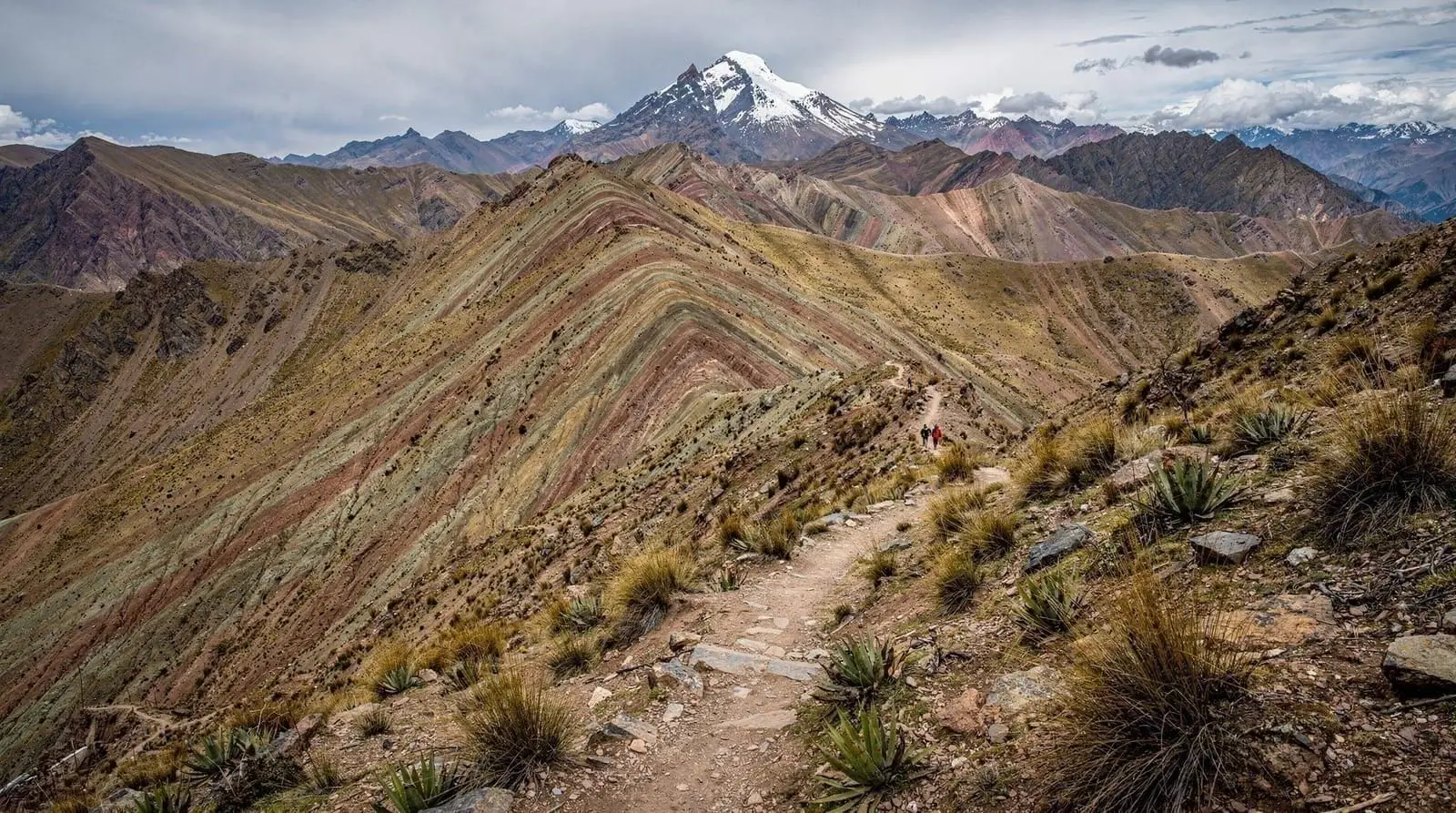
Palccoyo gives you three rainbow ridges instead of one, plus a red valley and a stone forest, all reached by an easy near-flat walk rather than a steep climb. It is the gentler, quieter version of the same mineral colours.
Three mountains in one, and almost nobody there
When people say “Rainbow Mountain” they usually mean Vinicunca, the single striped ridge that exploded across social media in the late 2010s and now pulls big crowds and a hard high-altitude climb. Palccoyo is its lesser-known cousin in the same Vilcanota range, and for a lot of travellers it is the better mountain — not despite being quieter, but because of it.
The reason Palccoyo wins people over is variety. Instead of one ridge, you get three rainbow-striped formations spread along an easy ridge walk. Off to one side drops the Valle Rojo, a deep red valley of iron-rich earth. On the other side rises the bosque de piedras, a “stone forest” of weathered rock spires. All of it sits within a gentle 30-to-45-minute walk of the car park, so you spend your energy looking around rather than gasping up a slope. And because it is less famous, you share the view with far fewer people.
This guide is the deeper companion to the practical Palccoyo day-trip planner. It covers what you are actually looking at, how the colours form, the three viewpoints, when to go for the best chance of clear stripes, and an honest, point-by-point comparison with Vinicunca so you can pick the right mountain for your trip.
| Where | Vilcanota range, about 3.5-4 hours southeast of Cusco |
| Cost | Full-day tour plus S/10-25 community entry fee |
| Time needed | 1.5-2 hours at the viewpoints, full day round trip |
| Getting there | Organised day tour from Cusco (near-essential) |
| Best time | Dry season (May-September), morning before cloud builds |
Why the mountains are striped
The colours are not paint and not a trick of the light — they are geology. Over tens of millions of years, layers of mineral-rich sediment were laid down, then tilted and folded as the Andes rose. Each layer carries a different chemistry, and as that rock weathers and oxidises at the surface, the minerals show their colours:
- Reds and pinks come from iron oxides (rust, essentially).
- Yellows and golds come from iron sulphides and oxidised limonite.
- Greens come from chlorite and copper-bearing minerals.
- Whites and creams come from quartz-rich sandstones and calcium carbonate.
- Lavenders and browns come from mixed clays and manganese.
Because the layers were folded and then sliced by erosion, you see them edge-on as parallel stripes running across the slopes. The same process built Vinicunca; Palccoyo simply exposes it across a broader, gentler landscape. The Valle Rojo nearby is so red because its soil is unusually iron-heavy.
The three viewpoints
The rainbow ridges
The main event. From the car park, the easy walk leads to a ridge where several striped formations line up. Morning light makes the colours pop; midday haze and cloud flatten them. Walk the ridge a little and the angles change, giving you different compositions of the same hills.
Valle Rojo (the red valley)
A short detour reveals a valley flushed deep oxide-red, often with a contrasting band of green vegetation or another mineral colour cutting through it. Many visitors find it more striking than the rainbow ridges themselves, and it is far less photographed.
The stone forest (bosque de piedras)
On the approach or as a side walk, a cluster of tall, weathered rock pillars stands like a petrified forest. It is a complete change of texture from the smooth coloured hills and worth the few extra minutes.
Having three distinct features in one stop is Palccoyo’s real selling point over Vinicunca’s single ridge. Budget 1.5 to 2 hours up top to see all three without rushing.
When to go
Dry season (May to September) is the safest window: clear skies, reliable sun, firm trails, and the best odds of seeing the stripes uncovered. It is also the busiest stretch in the Cusco region generally, though Palccoyo stays quiet relative to Vinicunca even then.
Shoulder months (April and October) offer a good balance — greener surroundings, thinner crowds, and mostly cooperative weather.
Rainy season (November to March) brings afternoon storms, muddy trails, and a real risk of fresh snow hiding the colours entirely. Mornings can still be clear, so an early visit sometimes works, but it is a gamble. Some travellers swear the colours look richest just after rain has washed the dust off — true, but only if it is not snow.
Whatever the month, go in the morning. High peaks reliably cloud over by midday, and a late visit risks a grey, washed-out view. For the wider seasonal picture around Cusco, see the best time to visit Cusco guide.
Altitude and weather
Palccoyo’s viewpoints sit at roughly 4,900 m (16,100 ft) — essentially the same height as Vinicunca and far above Cusco. The walk is easy, but the air is not. The rules that matter:
- Acclimatise for at least two or three days in Cusco or the lower Sacred Valley before going. The short walk does not exempt you from altitude sickness.
- Move slowly, even on flat ground.
- Dress for everything: it can be sunny, freezing, windy and snowy within the same hour. Layers, windproof shell, hat, gloves, sunglasses and strong sunscreen are all essential.
The full altitude strategy is in the altitude sickness guide and the Cusco acclimatisation plan.
Palccoyo vs Vinicunca, honestly
| Factor | Palccoyo | Vinicunca |
|---|---|---|
| Walk | 30-45 min, near-flat | 90 min, steep climb |
| Crowds | Light | Heavy in high season |
| Peak altitude | ~4,900 m | ~5,000 m |
| Extra sights | Red valley + stone forest | Single ridge only |
| Drama of main view | Broad, layered | One iconic striped ridge |
| Drive from Cusco | ~3.5-4 hours | ~3 hours |
Pick Palccoyo if you want the colours without the climb, you are worried about altitude or fitness, you are with kids or older relatives, or you value space over the iconic single-ridge shot.
Pick Vinicunca if the specific famous ridge is your goal and you are confident in your acclimatisation and stamina, accepting the crowds and the hard ascent.
For travellers who want both wilderness and altitude beyond either, the Ausangate region offers high lakes and multi-day trekking in the same range.
Photography and getting the best of it
The colours of any rainbow mountain are at the mercy of light and weather, and Palccoyo rewards a little planning.
Time of day. Morning is best, full stop. The low sun rakes across the slopes and brings out the contrast between the mineral bands, and the sky is most likely to be clear before the daily build-up of cloud over the peaks. By early afternoon the light flattens and the high summits often vanish into grey.
Angles. Walk the ridge rather than shooting from the first viewpoint. Moving even fifty metres changes which stripes line up and how the red valley reads against the sky. The stone forest gives a completely different texture and foreground if you want variety in your shots.
Managing expectations. The real colours are earthy and natural — soft reds, ochres, sage greens and creams — not the cranked neon of heavily edited posts. They are genuinely beautiful in person, but if you arrive expecting the over-saturated marketing version you may feel briefly let down before the scale and quiet of the place win you over.
The people and animals. Local families graze llamas and alpacas near the viewpoints, and some pose in traditional dress. If you photograph them, agree a small tip (S/2-5) first. It is fair payment, and it keeps the relationship between visitors and the community honest.
For the broader question of light and weather across the Cusco high country, the best time to visit Cusco guide is the companion read.
How to visit
Palccoyo is remote and reached almost exclusively on organised day tours, which handle the very early pickup, the long drive, meals, and the trailhead logistics. The full-day Palccoyo rainbow mountain all-inclusive tour from Cusco bundles transport, breakfast, lunch and a guide. Confirm whether the local community entry fee (around S/10-25) is included or paid in cash at the trailhead.
The complete day-trip logistics — schedule, packing, costs — are in the Palccoyo day-trip guide, and you can see how it stacks up against other excursions in the best day trips from Cusco guide.
Tourist traps and honest warnings
The flat walk lulls people. Easy gradient, hard altitude. The most common mistake is treating Palccoyo as a casual outing and skipping acclimatisation.
Snow and cloud risk. In the rainy season the stripes can be hidden by snow or lost in cloud. If clear colours matter to you, come in dry season and go early.
Hidden entry fees. Some budget tours quote low and collect the community fee at the trailhead. Ask what is included.
Over-edited photos. Many marketing images crank the saturation. The real colours are lovely but subtler than the posters — expect natural earth tones, not neon.
Respecting the community. The land belongs to local Andean communities. Pay the fee, tip for photos with alpacas, and tread lightly.
A closer look at the geology, for the curious
Understanding a little more about how these stripes formed makes the walk itself far more interesting. The layered sediments at Palccoyo were originally laid down as horizontal beds on an ancient seabed or floodplain, tens of millions of years before the Andes existed as mountains at all. As the Nazca oceanic plate began subducting beneath the South American plate, immense pressure folded and tilted these once-flat layers, sometimes to near-vertical angles, while pushing the whole region skyward. Millions of years of subsequent erosion by wind, rain, and glacial ice then stripped away the softer rock unevenly, exposing the tilted, differently coloured bands edge-on — which is why you see stripes rather than a single uniform hillside.
The same tectonic forces that folded these rocks are still active today: this stretch of the Andes remains seismically alive, and the mineral-rich waters draining from these slopes feed the high wetlands where alpaca herds graze. Guides at Palccoyo increasingly point this out, framing the rainbow colours not just as a photogenic curiosity but as a visible cross-section of the mountain-building process that created the entire Andean range you are standing in.
Practical logistics beyond the viewpoints
Most travellers focus entirely on the walk and forget the practicalities that make or break the day. Toilets exist near the car park for a small fee, and a handful of stalls sell water, snacks, and hot drinks, but do not expect much beyond that — bring your own food and full water bottle from Cusco. Mobile signal is patchy to non-existent once you leave the paved road, so download offline maps and let someone know your plan if you are travelling independently rather than on a tour.
For the fuller hour-by-hour schedule, packing list, and cost breakdown of the day trip itself, see the Palccoyo day-trip guide, which is the practical companion to this deeper geology-and-comparison piece.
Frequently asked questions about Palccoyo rainbow mountain
Why is Palccoyo coloured like a rainbow?
When is the best time to visit Palccoyo?
Does snow cover the colours at Palccoyo?
How many viewpoints are there at Palccoyo?
Is Palccoyo good for families or older travellers?
How does Palccoyo compare to Vinicunca on crowds?
Top experiences
Bookable activities with verified prices and instant confirmation on GetYourGuide.
